
Texas Leads the Nation in Hail Damage — Here’s What Homeowners Need to Know
Hail damage to roofs in Texas is an annual certainty, not a rare event. For fast local documentation after a storm, work with a Texas and Oklahoma roofing contractor that understands hail patterns, insurance evidence, and compliant repair standards. Texas recorded 878 individual hail events in 2024, more than any other state, generating over $1 billion in damage. One 2023 storm in the Dallas-Fort Worth area alone caused an estimated $7 to $10 billion in insured losses.
Here is what Texas and Oklahoma homeowners need to know right away:
- File fast: Texas law requires hail damage claims to be filed within one year of the storm date under Texas Insurance Code §542A.003
- Know your deductible: Wind and hail deductibles in Texas are typically 1%–5% of your dwelling coverage — not a flat dollar amount
- Cosmetic vs. functional damage: Insurance carriers only pay for functional damage that compromises the roof’s ability to shed water
- Do not waive your deductible: It is illegal in Texas for a contractor to absorb or offset your deductible under House Bill 2102
- RCV vs. ACV matters: Roofs over 15 years old are often shifted to actual cash value coverage, which pays significantly less at claim time
- Get a local inspection first: Schedule a professional storm damage roof inspection with a GAF-certified roofing contractor before contacting your insurer — proper documentation can be the difference between a full payout and a denied claim
Both Texas and Oklahoma have specific laws that affect how storm damage claims are filed, what contractors can legally do on your behalf, and how much you will actually receive after a hailstorm. Navigating these rules without knowing them can cost you thousands.
If your home was hit and you suspect damage, Safe Roof’s hail damage roof repair services are available across Texas and Oklahoma to help you document, file, and restore correctly.
I’m Jacob Ortiz, owner of Safe Roof, a GAF-certified roofing contractor serving homeowners across Texas and Oklahoma — two of the most hail-active states in the country. My team handles hail damage roof Texas claims daily, from initial inspection through final insurance settlement, and I’ve seen how the right documentation and local expertise change outcomes.
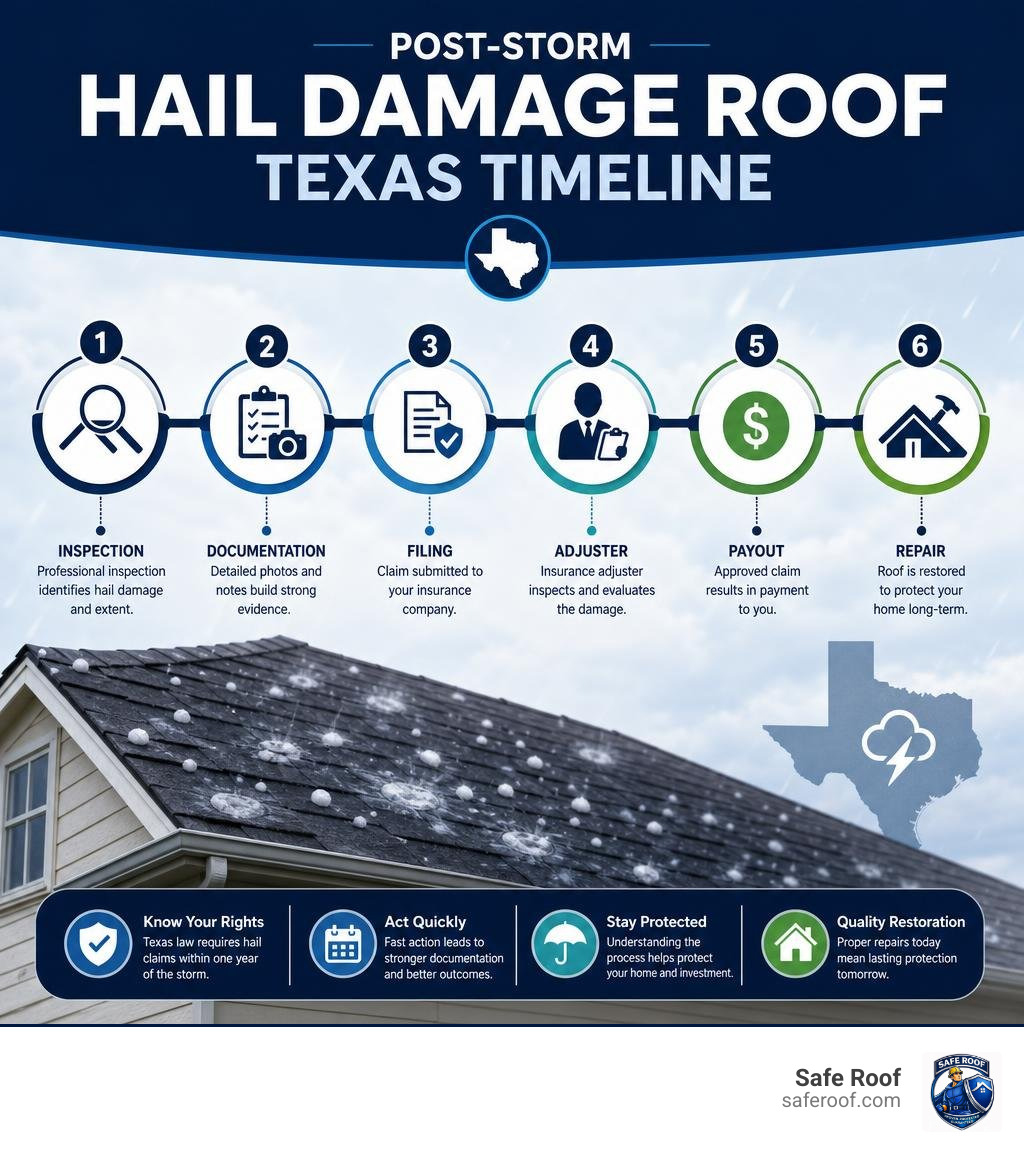
Hail damage roof texas basics:
Identifying Hail Damage Roof Texas Standards
To successfully navigate a storm restoration project, you must understand how insurance carriers evaluate hail damage. Under standard Texas property insurance policies, there is a strict legal and operational boundary between cosmetic blemishes and functional structural damage.
Cosmetic damage refers to surface-level changes that do not affect the life expectancy of the roof or its ability to shed water. Functional damage, on the other hand, represents structural alterations that compromise the roof’s performance, immediately or progressively reducing its service life.
When a hailstorm sweeps through communities like Dallas TX, Plano TX, or Oklahoma City OK, it leaves behind a mix of both. The primary indicators of functional damage include:
- Shingle Bruising: A physical rupture of the asphalt shingle’s internal fiberglass mat. This occurs when a high-velocity hailstone compresses the shingle against the roof deck, leaving a soft spot you can feel with your thumb.
- Granule Loss exposing the asphalt mat: Mineral granules shield the underlying asphalt from destructive ultraviolet (UV) radiation. When hail knocks these granules loose, it exposes the black asphalt layer, which rapidly degrades under the intense North Texas and Central Oklahoma sun.
- Fractured Shingle Mats: Severe impacts split or crack the fiberglass matting entirely, leaving an open path for wind-driven rain to reach the roof deck.
- Collateral Damage: Dents on soft metals (such as aluminum box vents, valleys, gutters, and downspouts) and flattened fins on outdoor HVAC units. While these metals display cosmetic dents easily, they serve as crucial physical evidence of the storm’s severity and directionality.
| Damage Type | Visual Appearance | Structural Impact | Insurance Status |
|---|---|---|---|
| Cosmetic | Minor scuffs, shallow metal dents, superficial granule displacement | None; the shingle mat remains fully intact and watertight | Typically excluded from replacement coverage |
| Functional | Deep soft bruises, fractured fiberglass matting, exposed black asphalt | High; compromises the roof’s water-shedding ability and accelerates aging | Fully covered under standard RCV policies |
How to Spot Real Hail Damage Roof Texas Indicators
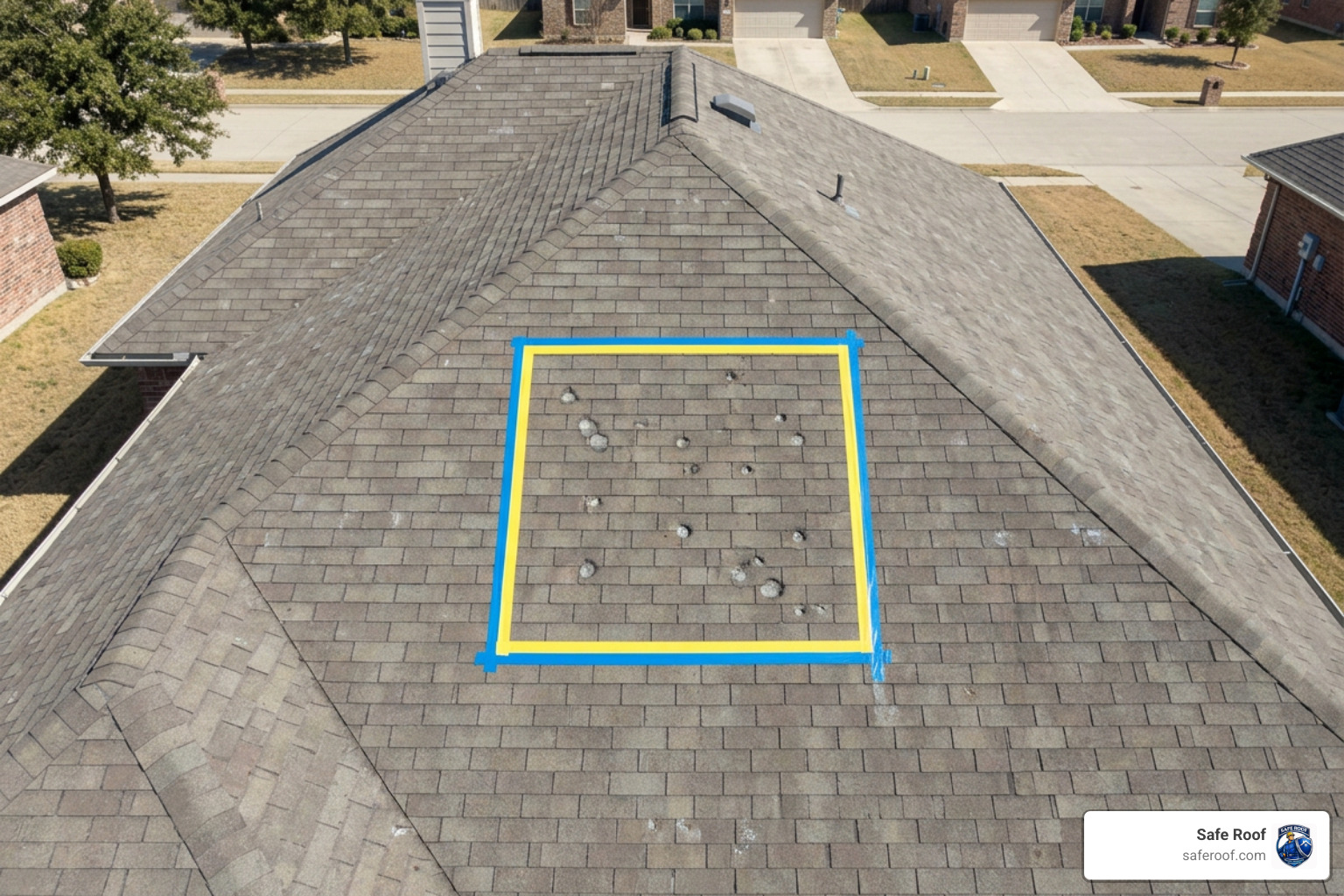
Insurance adjusters do not guess when determining if a roof requires a full replacement. They use a standardized, objective evaluation method known as the 10×10 test square methodology.
An adjuster will outline a 100-square-foot area (a “square” in roofing terms) on each major slope of your roof (North, South, East, and West). Within each test square, they count the number of verified, functional hail strikes.
As a general rule, 7 to 10 visible hail damage impacts within a 10×10 foot test area will trigger a full roof replacement. Most insurers operating in Texas and Oklahoma require at least 8 confirmed strikes per square to approve a full replacement claim. If the strike density is below this threshold, the carrier will likely only approve localized repairs.
Your roof’s age and material type heavily influence its vulnerability to hail. Older asphalt shingles lose their natural oils over time, becoming brittle and far more susceptible to mat fractures. For example, a 15-year-old organic-mat shingle can suffer functional damage from 1-inch (quarter-sized) hail, whereas a brand-new laminated architectural shingle might withstand 1.5-inch hail with only minor cosmetic granule loss.
To help you understand what to look for and when to take action, we recommend reading our detailed guides on how to spot real hail damage on your roof and when to worry about minor hail damage.
Safe Ground-Level Inspections and Solar Complications
We strongly advise against climbing onto your roof after a storm. Wet shingles, steep pitches, and structural compromises make DIY roof walks incredibly dangerous. Instead, you can safely gather initial evidence from the ground.
Start by walking the perimeter of your home with a pair of binoculars. Look for signs of impact on your siding, window screens, and downspouts. Check your gutters and the ground beneath your downspouts for excessive accumulations of asphalt granules. Finally, inspect your attic or top-floor ceilings for active water stains or moisture intrusion, which indicate that water-shedding barriers have already failed. If you find signs of water entry, you should immediately seek professional leak detection services to prevent mold and rot.
If your home in McKinney TX or Prosper TX features solar panels, the inspection process becomes significantly more complex. Solar panels and their mounting brackets can mask underlying roof damage. Hailstones can slide under the panels, striking the shingles at odd angles, or damage the critical flashing around the solar mounts.
Because removing and reinstalling solar panels to inspect or replace a roof can cost thousands of dollars, it is vital to have a professional handle your roof inspections. A certified inspector will evaluate the structural integrity of both the exposed roofing materials and the areas surrounding your solar penetrations.
Texas and Oklahoma Insurance Laws and Deductible Rules
When filing a hail claim in the DFW Metroplex or Central Oklahoma, your financial recovery depends entirely on your policy type: Replacement Cost Value (RCV) or Actual Cash Value (ACV).
An RCV policy covers the actual cost to repair or replace your damaged roof at current market prices, minus your deductible. The carrier pays this in a “two-check” structure. First, they issue an ACV check based on the depreciated value of the roof. Once the work is completed and proof of payment is submitted, they release the remaining “recoverable depreciation” check.
Conversely, an ACV policy only pays for the valued worth of the roof at the time of the storm, accounting for age, wear, and tear. If you have a 12-year-old roof under an ACV policy, your insurer will deduct 50% or more for depreciation, leaving you to cover the remaining balance out of pocket.
Many homeowners face what we call the 15-year cliff. In both Texas and Oklahoma, insurance companies frequently transition older roofs from RCV to ACV coverage automatically upon policy renewal. It is critical to review your policy declarations page annually to ensure your coverage hasn’t been quietly downgraded.
Time is also a critical factor. Under Texas Insurance Code §542A.003, policyholders generally have exactly one year from the date of the storm to file a property damage claim. Oklahoma regulations also emphasize prompt reporting. If you delay filing, subsequent weather events can make it impossible to isolate which storm caused the specific damage, giving the carrier a legal reason to deny your claim.
Navigating Deductibles and the Legality of Waiving Fees
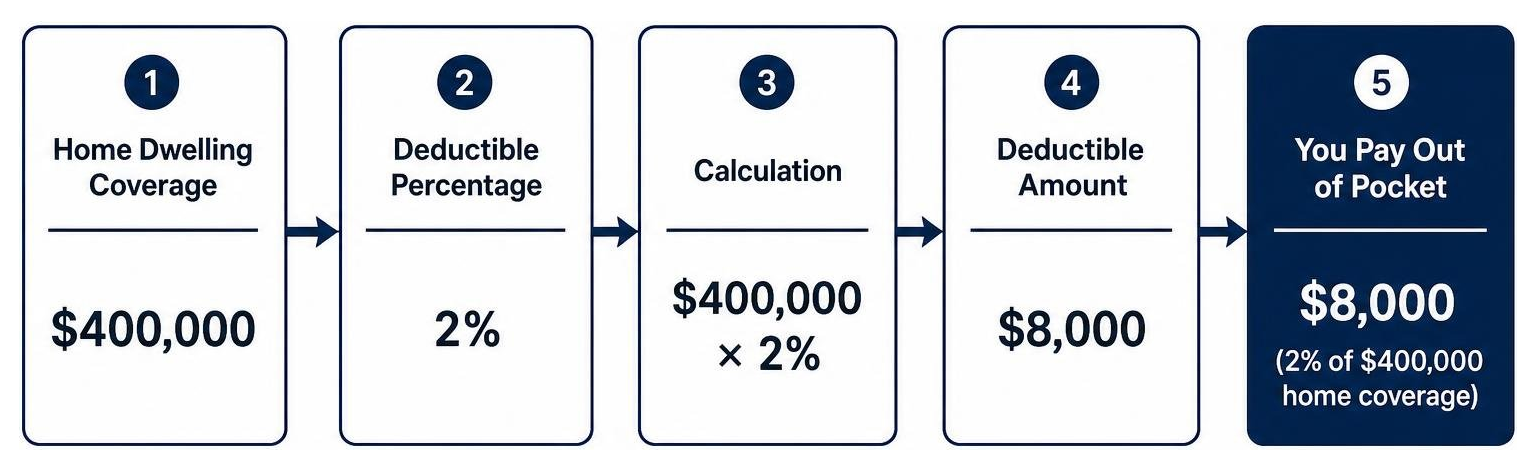
In Texas and Oklahoma, wind and hail deductibles are rarely flat dollar amounts. Instead, they are structured as a percentage of your home’s total dwelling coverage (usually 1% to 5%).
For example, if your home in Celina TX or Sherman TX is insured for $400,000, a 2% wind and hail deductible means you must pay $8,000 out of pocket before your insurance coverage kicks in.
In the past, some roofing contractors offered to “waive,” “absorb,” or “offset” deductibles to win business. This is now highly illegal.
Under Texas House Bill 2102 (effective September 1, 2019), it is a Class A misdemeanor for a contractor to pay, waive, absorb, or rebate any portion of an insurance deductible. The law requires homeowners to pay their full deductible, and insurance companies have the legal right to request proof of payment—such as a cleared check, credit card receipt, or bank statement—before releasing the final recoverable depreciation payment.
To help you understand the claims process without breaking the law, we have put together a comprehensive beginner’s guide to insurance roof claims. If you need step-by-step guidance on communicating with your adjuster, our team is always ready to provide insurance claims assistance to ensure you remain fully compliant.
Resolving Denied Claims and the Role of Public Adjusters
If your insurance carrier denies your claim or offers an insufficient payout, you are not out of options. You can formally dispute the decision.
The most common mechanism for resolving disputes over the amount of loss is the appraisal process. Under the appraisal clause in standard policies, both you and the insurance company hire independent appraisers to evaluate the damage. If the two appraisers cannot agree, an independent umpire makes the final determination. If you believe your carrier is acting in bad faith or violating state regulations, you can also file a formal complaint with the Texas Department of Insurance (TDI) or the Oklahoma Insurance Department.
When dealing with a disputed claim, many homeowners choose to hire a public adjuster or an attorney. According to historical insurance industry data, policyholders who utilize professional advocates during the claims process secure payouts that average 308% higher than those who negotiate directly with insurance carriers.
However, you must weigh this benefit against the cost, as public adjusters and attorneys typically charge a contingency fee of 10% to 33% of the total settlement. For a look at how systemic claim handling issues can impact policyholders, you can read about real-world disputes in this report on the State Farm hail scheme controversies.
Repair vs. Replacement Decisions After a Hailstorm
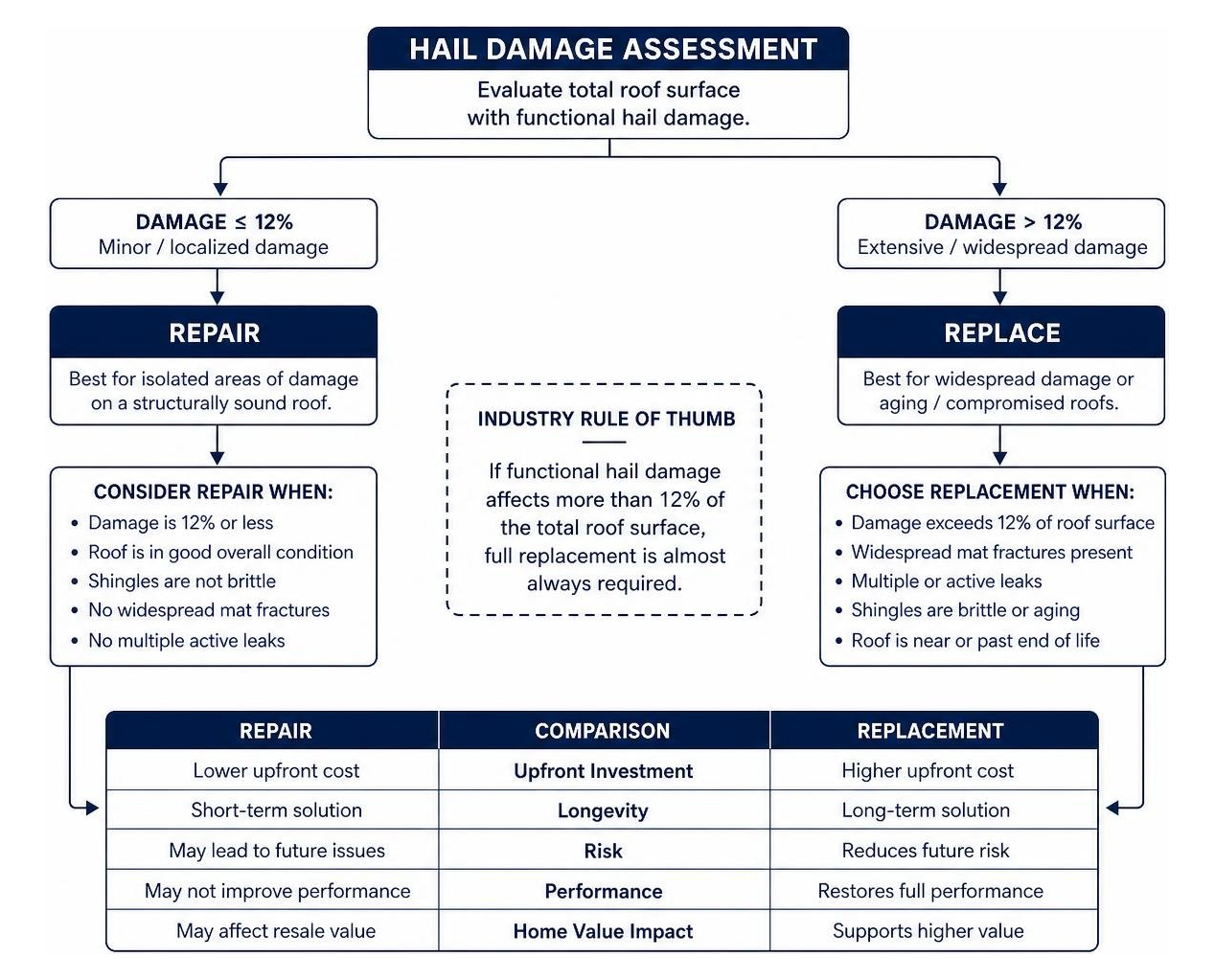
Deciding whether to repair localized areas or replace your entire roof depends on the extent of the damage. In the roofing industry, we use the 12% damage threshold as a practical rule of thumb.
If functional hail damage affects more than 12% of your total roof surface, a complete replacement is almost always required. Beyond this point, performing dozens of individual shingle repairs becomes economically impractical.
Piecemeal repairs on an aging roof can also create serious long-term issues. When shingles become brittle with age, attempting to slide new shingles into place requires breaking the seals of the surrounding course. This often causes the older, fragile shingles to crack, creating new leak points and compromising the roof’s overall wind resistance. If your roof is nearing the end of its life, investing in localized repairs is often a temporary fix that costs more over time than a complete system replacement.
To help you make the right choice, you can review our specialized services for both roof repair and complete roof replacement.
When to Choose Full Replacement for Hail Damage Roof Texas Properties
A full roof replacement is the safest and most cost-effective option when you are dealing with widespread mat fractures, multiple active leaks, or a brittle shingle system that cannot support repairs.
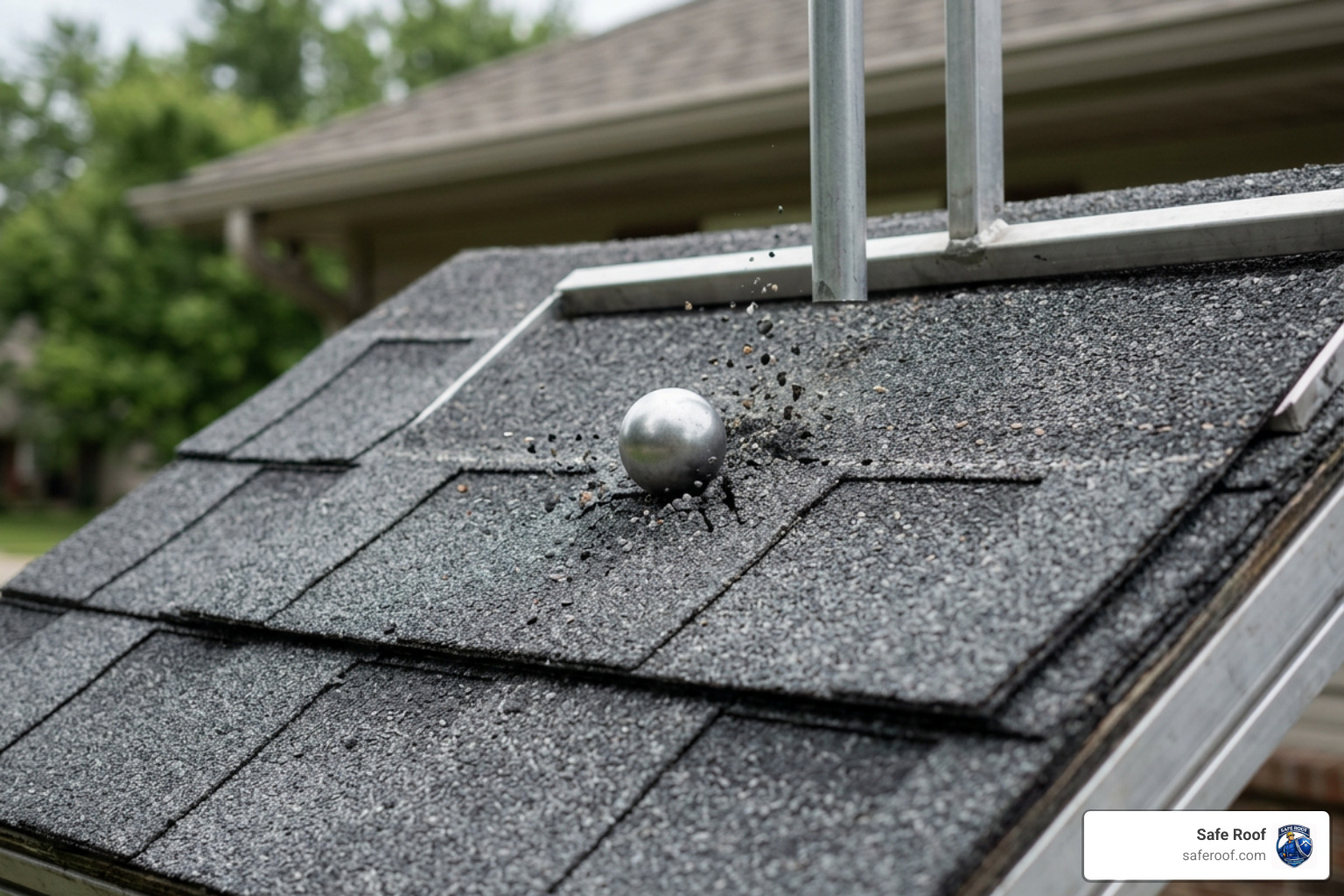
When replacing your roof in storm-prone areas like Collin County TX or Central Oklahoma, we highly recommend upgrading to Class 4 impact-resistant shingles. These shingles are engineered and tested to withstand the impact of a 2-inch steel ball dropped from a height of 20 feet without cracking.
Upgrading to Class 4 shingles offers several key benefits:
- Premium Discounts: Most major insurance carriers in Texas and Oklahoma offer annual premium discounts of up to 25% for homes with certified Class 4 roofs.
- Enhanced Durability: They easily withstand the standard 1-inch to 1.5-inch hailstorms that frequently damage standard shingles.
- Extended Lifespan: These shingles maintain their structural integrity far longer under extreme weather conditions.
As a GAF-certified contractor, we specialize in installing high-performance systems that meet strict GAF Shingle Specifications. To learn more about the steps involved in restoring your home’s protection, check out our guide on hail damage roof restoration steps.
Avoiding Storm Chasers and Hiring Local Contractors
Immediately following a major hailstorm, neighborhoods are often flooded by “storm chasers”—out-of-state contractors who travel from city to city following severe weather. While they may offer quick repairs, hiring them carries significant risks. They often perform substandard work, use cheap materials, and disappear long before any warranty issues arise.
When choosing a contractor, keep these critical guidelines in mind:
- Verify Public Adjusting Limits: Under Texas Insurance Code §4102.163, roofing contractors are strictly prohibited from acting as public adjusters. A contractor cannot legally negotiate, adjust, or settle an insurance claim on your behalf. They can only provide factual damage reports and detailed estimates for your insurer to review.
- Look for Local Credentials: Ensure your contractor has a permanent physical office in your area (whether in North Texas or Southern Oklahoma) and holds a valid license from the Roofing Contractors Association of Texas (RCAT) or is registered with the Oklahoma Construction Industries Board.
- Avoid Upfront Payment Schemes: Never sign a contract with a door-knocker on the spot or pay for the entire project upfront. Reputable local contractors will only ask for payment once materials are delivered or after specific phases of the work are completed.
To protect yourself from common post-storm scams, read our detailed articles on roofing contractor red flags, steps to take when hiring a hail contractor, and our homeowner guide to insurance-approved contractors.
Frequently Asked Questions about Texas and Oklahoma Roof Replacement Rules
Navigating storm restoration requires a clear understanding of the guidelines established by the Texas Department of Insurance (TDI) and the Oklahoma Construction Industries Board. Below are direct answers to the most common questions homeowners ask after a storm.
Is it legal for a contractor to waive my deductible in Texas?
No, it is highly illegal for a contractor to waive, absorb, or offset an insurance deductible in Texas under House Bill 2102. Violating this law is a Class A misdemeanor for both the contractor and the homeowner.
Texas law requires policyholders to pay their full deductible out of pocket. Insurance companies are legally entitled to request proof of this payment—such as a cleared personal check, credit card receipt, or bank transaction record—before releasing the final recoverable depreciation check. Any contractor offering to “free you from your deductible” is asking you to participate in insurance fraud. If you need help understanding compliant documentation, use professional insurance claims assistance instead of a contractor who offers an illegal discount.
How long do I have to file a hail damage claim in Texas?
Homeowners generally have exactly one year from the date of the storm to file a hail damage claim under standard Texas policies and Texas Insurance Code §542A.003.
While some premium policies may offer a longer window, you should always file your claim as quickly as possible. If you wait, subsequent storms or normal wear and tear can make it incredibly difficult to prove which specific hail event caused the damage. This often leads to partial payouts or outright claim denials. A documented hail damage roof repair assessment and a timely roof inspection create the evidence insurers need to evaluate the loss accurately.
Will filing a hail damage claim raise my insurance premiums?
No, insurance companies operating in Texas and Oklahoma cannot raise your individual premiums solely because you filed a claim for an “Act of God,” such as a hailstorm.
However, your premiums may still increase. Insurance companies regularly adjust rates on a regional scale across entire zip codes or territories based on the collective frequency of severe weather events. All property claims are recorded in the national CLUE (Comprehensive Loss Underwriting Exchange) database, which insurers use to assess overall regional risk. After a major weather event, professional storm damage restoration services help homeowners separate covered functional damage from normal aging before repairs begin.
Conclusion
When severe weather hits your home, you need a partner you can trust to navigate the complex world of insurance rules, state laws, and high-quality restoration.
Safe Roof is a premier, GAF-certified roofing contractor specializing in residential and commercial storm damage restoration across Texas and Oklahoma. We proudly serve homeowners in Dallas TX, Fort Worth TX, Plano TX, McKinney TX, Prosper TX, Celina TX, Sherman TX, Oklahoma City OK, Ardmore OK, and throughout Carter County OK.
Because we are GAF-certified, we can offer our customers enhanced 50-year system warranties that standard contractors simply cannot match. From our honest, no-pressure inspections to our comprehensive damage documentation, we ensure your home is restored safely, legally, and professionally.
If you suspect your roof has suffered wind or hail damage, do not wait for a leak to appear. Contact us today to schedule your professional assessment and learn more about our storm damage restoration services.