

Professional Roof Installation Services

A roof installation done right protects a home for 25 to 40 years. One done wrong creates the conditions for leaks, premature material failure, and voided warranties, sometimes within the first few seasons. The difference is not just the materials used. It is how every layer of the system is installed, in what sequence, and to what standard.

Safe Roof provides professional roof installation services for new construction and full replacement projects across Ardmore and Carter County. We are an Oklahoma Registered Roofing Contractor, fully licensed and insured. Every installation follows manufacturer specifications and Oklahoma building code requirements so your warranty is valid and your roof performs the way it was designed to.

What Roof Installation Covers

New roof installation applies in two situations: new construction, where a home is being built and has no existing roof system, and full replacement, where an existing system is removed and rebuilt from the decking up.

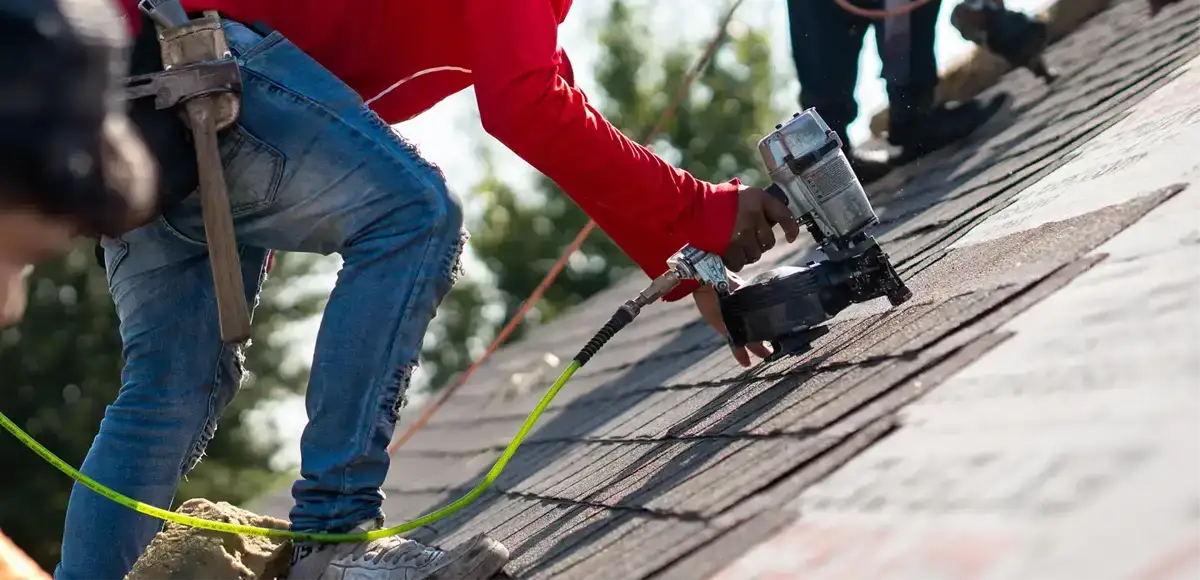
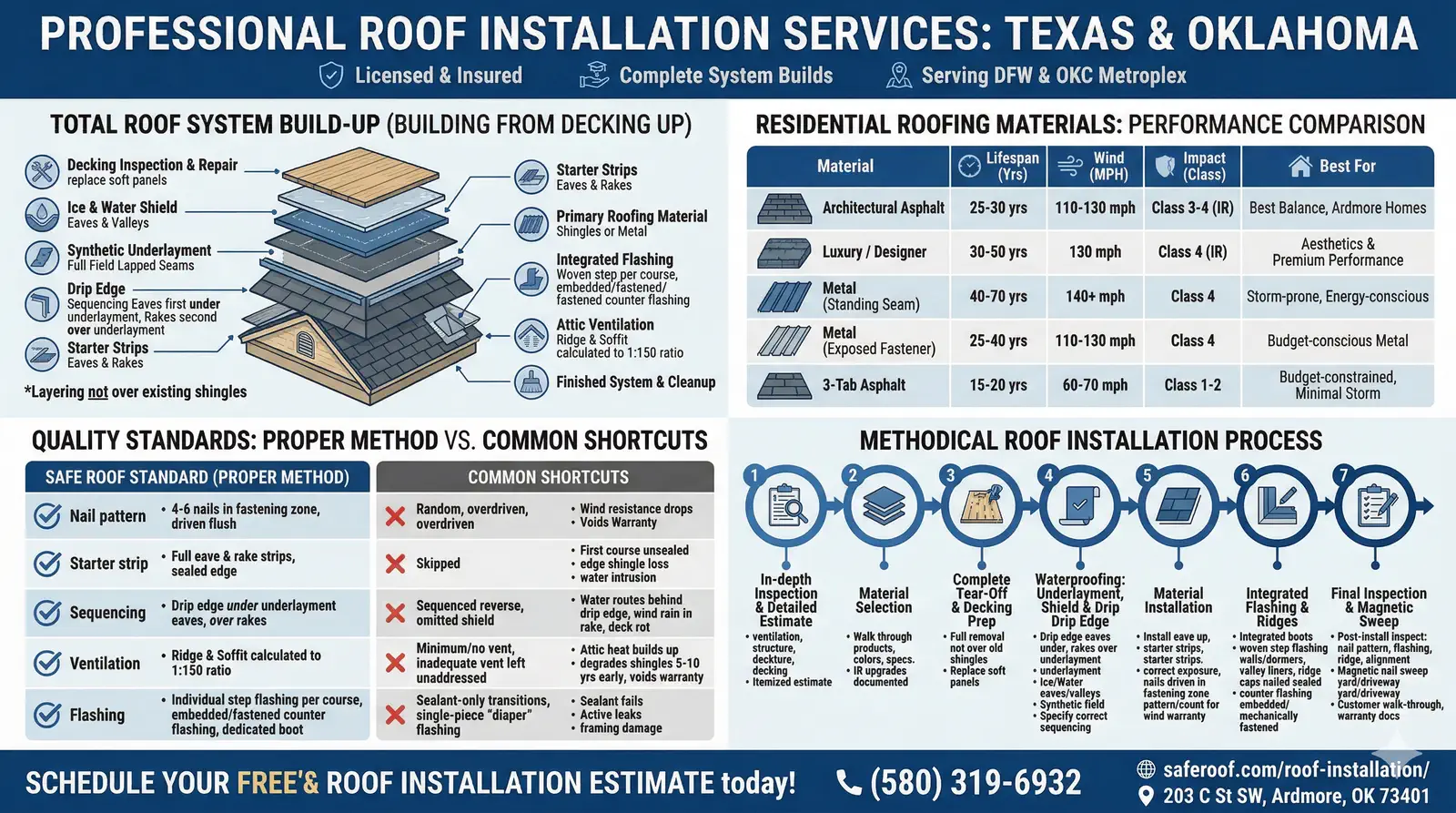
Both require the same methodical approach. Safe Roof does not install over existing layers. Every installation begins at the structural level, the decking, and builds the complete system above it. That means decking inspection and repair where needed, proper underlayment selection and installation, drip edge and starter strip placement, field shingle installation to the correct nail pattern and exposure, and ridge and hip cap finishing. Penetration flashing, pipe boots, and ventilation components are addressed as part of every installation, not as afterthoughts.

For homeowners planning a full roof replacement, the installation scope and process are detailed further on that page. This page covers the installation system, materials, and what makes a professionally installed roof perform differently from a hastily done one.

Our Roof Installation Process for Oklahoma and Texas Properties

A roof installation has a defined sequence. Every step must happen in order and must be done correctly before the next step begins. Skipping steps or reversing sequence, both common on rushed jobs, creates failure points that are invisible after the surface is finished but surface as leaks and warranty issues within a few years.

Step 1:  Inspection and Estimate 

Every installation begins with a free roof inspection of the existing structure, decking condition, current ventilation configuration, attic airflow, and any penetrations or transitions that will need flashing attention during the new installation. 

For replacement projects, we also assess whether the existing decking is sound enough to remain or needs full or partial replacement. You receive a written, itemized estimate with material options, performance specs, and warranty information before any work is scheduled.

Step 2: Material Selection 

We walk through shingle or metal product lines, available colors, and performance specifications. For homeowners evaluating Class 4 IR shingles, we document the upgrade and can provide the product certification needed for insurance premium adjustment requests. 

Owens Corning’s Duration® line, our primary shingle product, carries an ARMA-compliant installation guide, we provide a copy with every job package so homeowners have documentation that installation met manufacturer specifications.

Step 3: Tear-Off and Decking Prep 

Existing roofing material is fully removed down to the decking layer. We do not install over existing shingles. Layering adds weight,  a standard shingle layer weighs 2 to 4 pounds per square foot, and a second layer adds enough cumulative load to stress rafter connections in older homes. 

More importantly, installing over an existing layer makes it impossible to inspect or repair the decking, which is the structural base the entire system depends on. Decking is inspected panel by panel. Any soft, delaminated, or water-damaged panels are replaced with matched-thickness OSB or plywood before underlayment goes on.

Step 4: Underlayment, Ice and Water Shield, and Drip Edge 

Drip edge is installed at eaves first, before underlayment, so water that penetrates the shingle surface drains over the metal edge rather than behind it. Ice and water shields are applied at eaves and in valleys. Synthetic underlayment covers the full field with lapped seams per manufacturer requirements. 

Drip edge is then installed at rakes over the underlayment, completing the edge detail that manages wind-driven water at the perimeter. This specific sequencing, drip edge under underlayment at eaves, over at rakes, is the IRC-required installation order and the one most often reversed on shortcuts.

Step 5: Shingle or Metal Installation 

Shingles are installed from the eave up, with starter strips laid first at eave and rake edges. Each course follows the manufacturer’s specified exposure, the amount of shingle visible, which determines both water shedding performance and the visual line of the finished roof. 

Nails are driven within the fastening zone at the pattern and count required by the wind warranty. For metal installations, panel substrate, fastener type, thermal expansion clearances, and seam details are all product-specific and followed per the engineering documentation for the panel system being installed.

Step 6: Flashing, Penetrations, and Ridge 

All pipe boots, step flashing courses, valley liners, and ridge caps are installed as integrated components. Each pipe boot is sealed to the shingle surface. Step flashing pieces are woven into each shingle course along walls and dormers. Ridge caps are nailed through the nailer zone and sealed at exposed ends. For homes with chimneys, step flashing and counter flashing are installed with the counter flashing embedded or mechanically fastened, not sealant-only.

Step 7: Final Inspection and Cleanup 

We perform a complete post-installation inspection: nail pattern verification, flashing integrity check, ridge and hip cap sealing, and perimeter drip edge alignment. A magnetic nail sweep is conducted across the yard, driveway, and landscaping beds. We walk the finished system with you, provide the manufacturer warranty documentation and our workmanship warranty paperwork, and answer any questions before we leave the site.

Licensed Commercial & Residential Roofing Contractor

Trusted and licensed contractor for commercial and residential roofing—quality materials, expert service, and lasting protection guaranteed.

LICENSE NUMBER: 80004931

Roofing Materials We Install in Texas & Oklahoma

The roofing material installed on your home today determines how it performs through decades of Oklahoma and Texas weather, from spring hail storms across Collin County to the high-wind events that sweep through Carter County every season. Safe Roof stocks and installs product lines rated for the specific wind and impact conditions your property faces, and we match every recommendation to your home’s profile, budget, and long-term performance goals.

Residential Roof Installation Materials — Performance Comparison for Oklahoma & Texas Homes

Choosing a roofing material is one of the most consequential decisions in a roof installation project. The right material for an Ardmore-area home needs to perform under hail, handle wind speeds that regularly exceed 70 mph, and hold up through summer heat that can push attic temperatures above 150°F. The table below covers the primary residential materials Safe Roof installs and how each performs against the conditions Carter County homeowners actually face.

Material

Typical Lifespan

Wind Rating

Impact Rating

Oklahoma & Texas Suitability

Best For

3-Tab Asphalt Shingles

15–20 years

60–70 mph

Class 1–2

Minimum acceptable; not recommended for exposed locations

Budget-constrained installations with minimal storm exposure

Architectural Asphalt Shingles

25–30 years

110–130 mph

Class 3–4 (IR)

Strong fit; most common residential material in Carter County

Most Ardmore-area homes; best balance of cost and performance

Metal Roofing (Standing Seam)

40–70 years

140+ mph

Class 4

Excellent — handles Oklahoma hail and wind better than shingles

Long-term investment; storm-prone properties; energy-conscious homeowners

Metal Roofing (Exposed Fastener)

25–40 years

110–130 mph

Class 4

Good — lower cost than standing seam with strong wind performance

Outbuildings, barns, and budget-conscious metal installations

Luxury / Designer Shingles

30–50 years

130 mph

Class 4 (IR)

Excellent — premium weight resists hail impact better than standard shingles

High-visibility homes; homeowners seeking upgraded aesthetics and performance

Architectural Asphalt Shingles — Our Most Installed Product

For the majority of residential installations in Ardmore, architectural shingles are the right answer. They carry higher wind and impact ratings than 3-tab shingles, offer a dimensional profile that improves curb appeal, and are available in Class 4 impact-resistant versions that qualify for insurance premium discounts in most Oklahoma policies.

Safe Roof installs Owens Corning as our primary shingle product. Their TruDefinition Duration® line carries a 130 mph wind warranty and Class 4 IR rating,  specs that matter in a state where the U.S. Department of Energy identifies reflective and impact-resistant roofing as key factors in both energy savings and storm resilience for southern climate zones. Duration® shingles also carry a 10-year SureStart™ protection warranty and a 130 mph wind limited warranty for the life of the shingle. Browse the full range of asphalt shingle roofing options we carry.

Metal Roofing for Oklahoma and Texas Homes

Metal roofing is the right choice for homeowners who want the longest possible service life and the strongest storm resistance available. Safe Roof installs standing seam and metal panel systems across Texas and Oklahoma for homeowners who are done replacing a roof every 20 to 25 years.

  • Exceptional lifespan: A properly installed standing seam metal roof carries a service life of 40 to 70 years, two to three times the lifespan of an architectural shingle roof. On a per-year cost basis, metal frequently outperforms asphalt when full replacement cycles are factored in.
  • Superior storm resistance: Steel and aluminum panels used in residential metal roofing carry a 140+ mph wind rating and a Class 4 impact resistance rating, the highest classification available under both FM 4473 and UL 2218 standards. Unlike shingles, which lose granules and develop micro-cracks under severe hail impact, a Class 4 metal panel dents but maintains its full weatherproofing integrity.
  • Measurable energy savings: Reflective metal surfaces reduce roof surface temperatures by 50 to 60°F compared to dark asphalt shingles under direct sun. The U.S. Department of Energy estimates that ENERGY STAR-rated reflective metal roofs can reduce cooling energy use by 10 to 25% in hot climate regions, a meaningful range for Carter County homeowners where air conditioning accounts for a significant share of energy costs from May through September.
  • Long-term cost advantage: The higher upfront cost of metal, typically two to three times the cost of a mid-grade shingle installation per square, closes within 15 to 20 years through energy savings, eliminated replacement cycles, and reduced maintenance. For a home that will be owned long-term or passed to the next generation, the financial case for metal is strong.
  • Impact resistance backed by independent testing: Class 4 metal panels meet UL 2218 requirements through the inherent ductility of the metal substrate itself, not through a modified asphalt matrix or polymer blend. That distinction matters in Carter County and Collin County, where hail events regularly exceed one inch in diameter and roof surfaces take direct impact loads that lower-rated materials cannot absorb without permanent damage.

Luxury Shingles

For homeowners who want premium performance and upgraded aesthetics, luxury shingles offer the highest weight and impact resistance available in the asphalt product category. Owens Corning’s Berkshire® Collection and Woodcrest® lines deliver a dimensional profile and a Class 4 IR rating in a shingle that weighs more per square than standard architectural products, which translates directly to better hail performance and longer service life.
Why Choose Safe Roof

  • Oklahoma Registered Contractor. Fully licensed and insured on every job. You are protected if anything goes wrong,  an unregistered contractor without insurance leaves that risk entirely with you.
  • Owens Corning Preferred Product Line. We install Owens Corning as our primary shingle product, giving homeowners access to extended warranty coverage tied to our installer status. Every job comes with full warranty documentation before we leave the site.
  • GAF Certified Contractor. As a GAF-certified contractor, Safe Roof meets the manufacturer’s rigorous installation and quality benchmarks on every job, unlocking enhanced warranty options with up to 50-year coverage on materials and labor for qualifying installations.
  • Installed to Manufacturer Spec. Warranty-voiding conditions, off-pattern nailing, wrong exposure, inadequate ventilation, are buried in fine print. We install to the specifications that keep your manufacturer warranty valid and document the installation standard used on every project.
  • Storm Damage and Insurance Expertise. We document storm damage in the format carriers require and handle insurance claims assistance from documentation through adjuster coordination. If Class 4 IR shingles qualify for a premium discount on your policy, we provide the product certification your insurer needs.
  • Honest Assessments. If a residential roofing repair is the right answer, we say so. Our job is the right roof,  not the highest invoice.

What Separates a Proper Installation from a Poor One

Material quality only carries a roof as far as the installation behind it. Most premature roof failures in Oklahoma are not material failures, they are installation failures. The table below covers the five elements where proper installation diverges from a rushed job, and what happens downstream when each one is skipped or done wrong.

Roof Installation Quality Standards — Proper Method vs. Common Shortcuts

These details are invisible once the shingles are on. They determine whether a 30-year shingle delivers 30 years of service, or fails within the first decade. Safe Roof follows manufacturer specifications and IRC requirements on every installation so your warranty remains intact and your roof performs as engineered.

Installation Element

Safe Roof Standard

Common Shortcut

Consequence of Shortcut

Nail pattern and fastener placement

4 or 6 nails per shingle within the manufacturer’s specified fastening zone; nails driven flush, not overdriven

Random nailing outside the zone; overdriven nails that break through the shingle mat

Shingle wind resistance drops to 50–60 mph on a shingle rated for 110+ mph; voids manufacturer wind warranty

Starter strip installation

Full eave and rake starter strips installed; adhesive edge sealed; overhang dimension set to spec

Starter strips skipped to reduce material cost

First shingle course unsealed at edges; edge shingle loss in first high-wind event; water intrusion at eaves

Underlayment and drip edge sequencing

Drip edge under underlayment at eaves; ice and water shield in eave and valley zones; drip edge over underlayment at rakes

Drip edge sequenced in reverse; ice and water shield omitted

Water routes behind drip edge at eave; wind-driven rain infiltrates at rake; deck rot at perimeter

Attic ventilation

Ridge and soffit ventilation calculated to meet or exceed IRC 1:150 net free area ratio for each home’s attic volume

Minimum or no ventilation added; existing inadequate ventilation left unaddressed

Attic heat buildup degrades shingles 5–10 years ahead of schedule; granule loss; blistering; voids warranty

Flashing at penetrations and transitions

Individual step flashing pieces per shingle course; counter flashing mechanically fastened or embedded; dedicated boot at every penetration

Sealant-only flashing at transitions; single-piece “diaper” flashing rather than step flashing

Sealant fails within 3–7 years; active leak at wall-roof junction or penetration; framing damage begins

What Our Customers Say

Proudly Serving Texas & Oklahoma With Expert Roof Installation Services

Safe Roof provides complete residential roof installation services to homeowners and builders across Texas and Oklahoma, delivering licensed craftsmanship and premium materials on every new construction project, home addition, and full system build we take on. Our service areas include: Dallas, Far North Dallas, Fort Worth, Prosper, Celina, Plano, Sherman, McKinney, Oklahoma City, Ardmore and  surrounding areas. If you are looking for a broader view of our coverage, then see our full service area page here. Whether you are starting from the ground up on a new Celina home or adding a structure to your property in southern Oklahoma, our installation crews are equipped and ready to respond in your area.

Schedule Your Free Roof Installation Estimate in Texas & Oklahoma Today

Whether you are building new, adding a structure, or starting fresh after storm damage, the contractor you choose for your roof installation sets the standard for everything that goes on top of it. Safe Roof provides free, no-pressure roof installation estimates across our Texas and Oklahoma service area, backed by licensed craftsmanship, premium materials, and full warranty documentation on every project we complete.

Call (580) 319-6932, visit our free roof quote page, or reach out through our contact page to schedule your free roof installation estimate today.

Frequently Asked Questions

How long does a roof installation take in Texas and Oklahoma?

Most standard residential installations, a single-family home with a straightforward gable or hip roof, are completed in one to two days once materials are on site. Larger homes, steeper pitches, or roofs with significant penetrations and multiple planes may run two to three days. Safe Roof provides a project timeline as part of the written estimate.

What is the best roofing material for Texas and Oklahoma?

For most Texas and Oklahoma area homes, a Class 4 impact-resistant architectural shingle, such as Owens Corning TruDefinition Duration®,  is the best balance of cost, longevity, and storm performance. For homeowners who want the longest possible service life and maximum storm resistance, standing seam metal roofing is the strongest option available. Safe Roof installs both and can walk you through the specifics at your free inspection.

Does a new roof installation require a permit in Texas and Oklahoma?

Yes. Full roof replacements and new construction installations across Texas and Oklahoma require a building permit through the local authority having jurisdiction. Safe Roof handles the permit process as part of every installation,  permits are not optional and any contractor who offers to skip one in exchange for a lower price is creating a liability you will carry as the property owner.

Will my homeowner's insurance cover a new roof in Texas and Oklahoma?

If the existing roof was damaged by a covered event, hail, wind, or falling trees,  your policy likely covers the replacement minus your deductible. Safe Roof’s insurance claims assistance team documents the damage and coordinates with your adjuster to ensure the scope is fully covered. Age-related wear and maintenance failure are generally excluded.

How do I know if I need a full roof installation or just a repair in Texas and Oklahoma?

A roof inspection gives you a clear answer. In general, a system over 20 years old with widespread shingle deterioration, multiple failing sections, or compromised decking is a replacement candidate. A system under 15 years old with isolated storm damage from a single hail or wind event across our Texas and Oklahoma service area is typically a repair. Safe Roof gives you a specific recommendation based on what the inspection actually finds.

What warranty comes with a Safe Roof installation in Texas and Oklahoma?

Every installation includes Safe Roof’s workmanship warranty. For Owens Corning shingle installations, the manufacturer’s limited lifetime material warranty applies to the shingles, and the SureStart™ protection period covers full replacement cost for the first 10 years. Metal roofing warranties vary by product and manufacturer, we provide warranty documentation at the estimate stage so you know what is covered before you sign.

Safe Roof

Business Hours
Monday: Open 24 hours
Tuesday: Open 24 hours
Wednesday: Open 24 hours
Thursday: Open 24 hours
Friday: Open 24 hours
Saturday: Open 24 hours
Sunday: Open 24 hours

Your Elite Residential and Commercial Roofing Team in Texas & Oklahoma

Whether you’re dealing with storm damage, planning a replacement, or just want a professional opinion on your roof’s condition, Safe Roof is ready to help. We serve property owners across Texas and Oklahoma, showing up on time, doing the work right, and standing behind every install with GAF-certified warranty coverage.

Getting an estimate costs nothing and commits you to nothing. We’ll assess your roof, walk you through the findings, and provide a clear written estimate.