




Wind Damage Roof Repair Services
Oklahoma & Texas experience some of the most powerful wind events anywhere in the United States. From severe thunderstorm straight-line winds that regularly exceed 60 to 80 mph to the tornadoes that have made the state synonymous with violent weather, wind is a relentless threat to every roofing system in the Ardmore area. In 2025 alone, Oklahoma recorded 105 confirmed tornadoes, well above the long-term state average of 59 per year, and the March 14 wind event produced gusts up to 90 mph, making it the windiest day in Oklahoma Mesonet history. Carter County itself was included in a federal disaster declaration in 2024 following severe storms, straight-line winds, and tornadoes that swept through southern Oklahoma.
At Safe Roof, wind damage roof repair is a core part of what we do. Our storm damage roofing team responds quickly after wind events to inspect, document, and restore roofs for homeowners across Ardmore, Lone Grove, Wilson, Healdton, and surrounding communities. We understand the specific ways wind compromises residential roofing systems, and we provide the thorough documentation and insurance claims assistance that Oklahoma homeowners need to get their roofs repaired properly and their claims approved.
How Wind Damages Residential & Commercial Roofing Systems in Texas & Oklahoma
Wind does not need to reach tornado strength to cause significant roof damage. Severe thunderstorm winds between 58 and 80 mph, which occur multiple times per storm season in southern Oklahoma, are powerful enough to lift, crack, and remove roofing materials. Understanding the specific mechanisms of wind damage helps homeowners recognize why prompt inspection and repair are essential.
Shingle Lifting, Curling, and Blow-Off
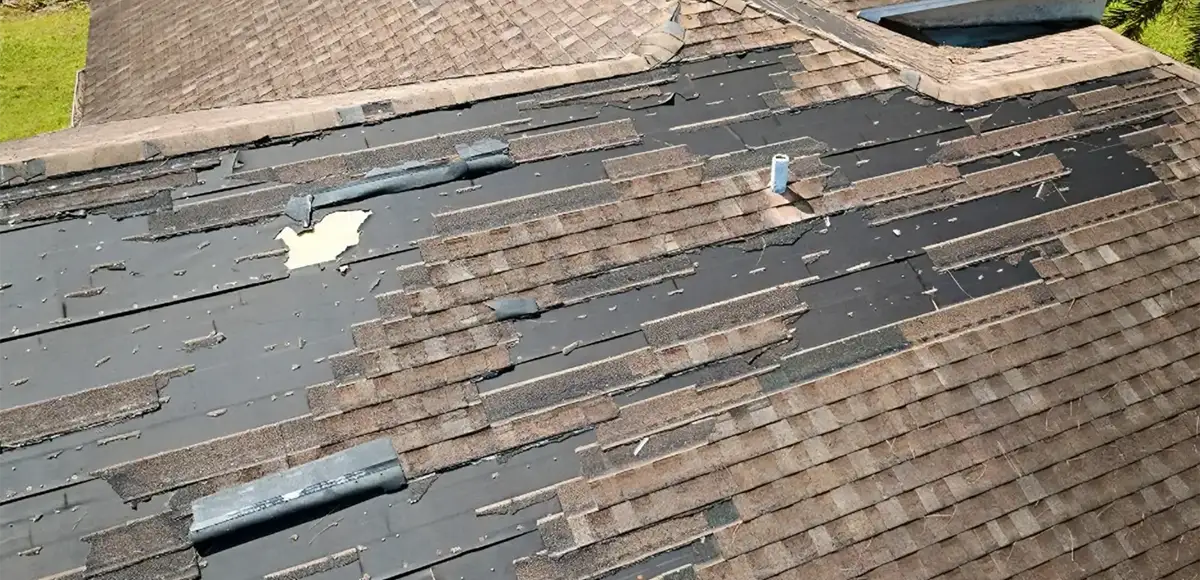
The most visible form of wind damage is shingle displacement. Wind creates negative pressure (suction) on the leeward side of a roof and positive pressure on the windward side, generating uplift forces that peel shingles away from the deck. Damage typically begins along edges, ridges, and eaves where wind forces are most concentrated, then progresses inward across the roof plane as shingles are successively exposed and lifted.
Once a single shingle is lifted or removed, the shingles around it become dramatically more vulnerable. Each missing shingle exposes the one above it to direct wind uplift from beneath, creating a cascading failure pattern where a storm that initially removes two or three shingles can strip an entire section of the roof during continued high winds. This is why even minor shingle blow-off after a windstorm is a serious concern that warrants immediate attention.
Broken Adhesive Seal Strips
Modern asphalt shingles are manufactured with thermally activated adhesive strips along their underside that bond each shingle to the one below it, creating a unified wind-resistant surface. High winds can break these adhesive bonds without visibly displacing the shingle. The shingle remains in place, appearing intact from the ground, but the broken seal means it is no longer secured against future wind events and now allows wind-driven rain to penetrate beneath it.
Broken seal strips are one of the most common and most underdetected forms of wind damage. A roof that survived one storm with seal strip failures is almost certain to lose shingles in the next significant wind event. Only a close-up inspection by a trained professional can identify this damage, which is why Safe Roof recommends a roof inspection after every severe weather event, even when everything looks normal from the driveway.
Flashing Damage and Displacement
Flashing, the metal strips and channels that seal transitions between the roof surface and structures like chimneys, vents, skylights, and walls, is highly susceptible to wind damage. High winds can bend, lift, or completely displace flashing, breaking the waterproof seal at these critical junctures. Because flashing protects the most leak-prone areas of any roof, even slight displacement can result in significant water intrusion during subsequent rain events.
Wind-driven debris compounds flashing damage. Flying branches, loose building materials, and other objects carried by storm winds can strike and dent flashing, breaking its seal against the roof surface. Safe Roof inspects all flashing points as part of every wind damage assessment to ensure these vulnerable areas are documented and repaired.
Soffit, Fascia, and Gutter Damage
The components that enclose your roof’s edge, soffits, fascia boards, and gutters, take direct wind impact and are frequently damaged during severe storms. When soffits are blown loose or torn away, they expose the attic and roof structure to wind-driven rain and debris. Bent or detached gutters fail to direct water away from the foundation, contributing to erosion and potential basement or crawlspace moisture problems. Damaged fascia boards allow moisture to reach the ends of rafters and roof decking, accelerating rot and structural deterioration.
These perimeter components are often overlooked in insurance claims because they are not technically part of the roofing surface, but they are essential to the overall performance of the roofing system. Safe Roof documents all wind damage to perimeter components alongside shingle and flashing damage to ensure your claim captures the complete scope of the storm’s impact.
Structural Wind Damage
In the most severe wind events, strong tornadoes and extreme straight-line winds, the forces applied to a roof can exceed the capacity of the structural framing. Rafters can crack, trusses can shift, and the roof deck itself can be pulled away from the supporting structure. Structural wind damage requires professional engineering assessment and comprehensive restoration that addresses every layer of the roofing system from the framing up.
If you notice sagging ridgelines, visible shifts in the roof plane, or interior ceiling displacement after a wind event, contact Safe Roof immediately for an emergency assessment. Structural roof repair is time-sensitive, and delaying evaluation can allow secondary water damage to compound the structural issues.
Areas We Serve
Licensed Commercial & Residential Roofing Contractor
Trusted and licensed contractor for commercial and residential roofing—quality materials, expert service, and lasting protection guaranteed.
LICENSE NUMBER: 80004931
Wind Speed Damage Guide — What Different Wind Speeds Do to Roofs in Texas & Oklahoma
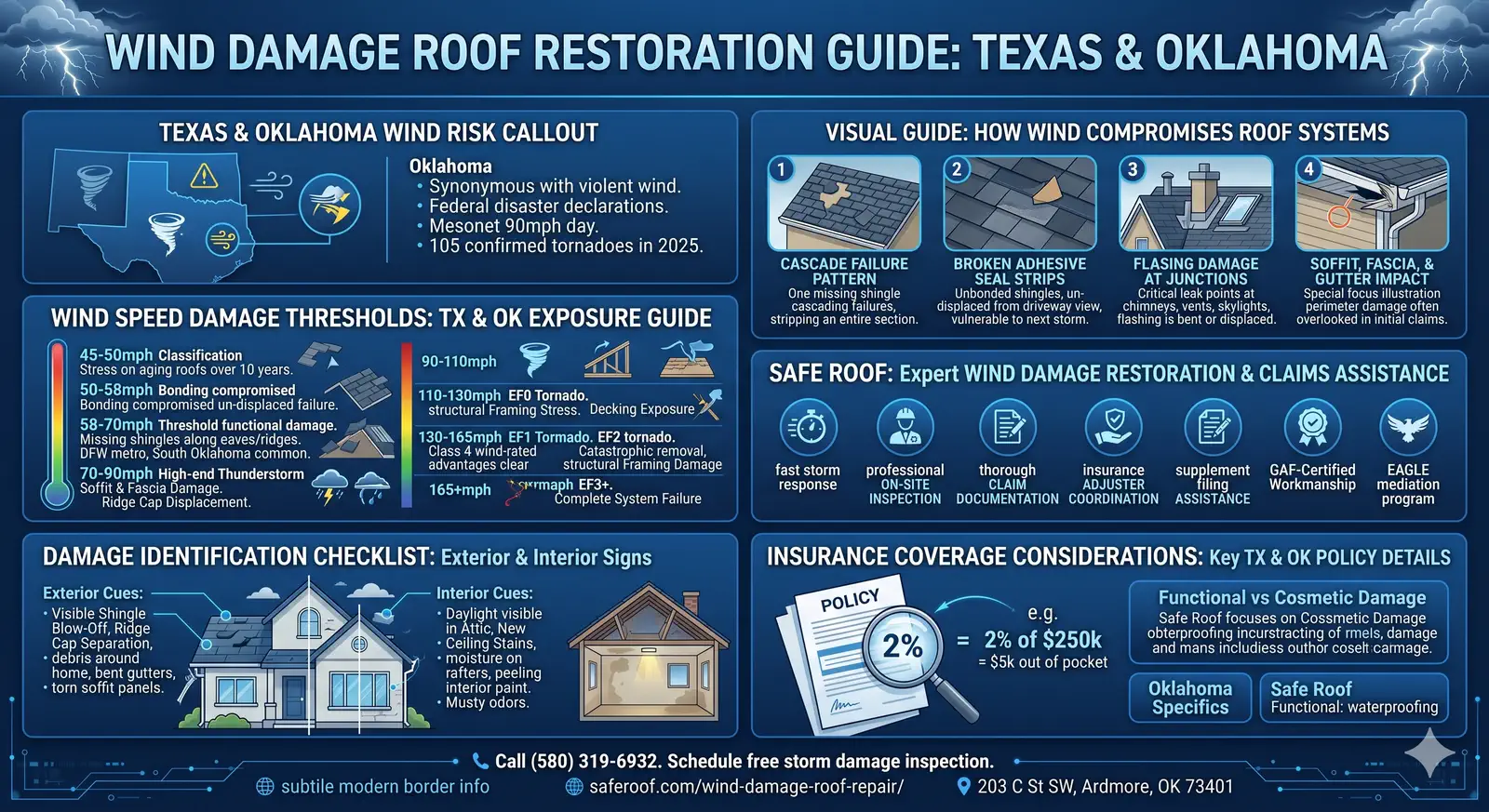
Texas and Oklahoma property owners are frequently surprised to learn how little wind speed is required to begin damaging a residential roofing system, especially on roofs with aging seal strips or previous storm exposure. This table covers the damage profile for each wind speed threshold, using the actual conditions our inspectors encounter across the DFW metro and South Oklahoma service area each storm season.
Wind Speed | Classification | Likely Roof Damage | TX & OK Occurrence |
45 to 50 mph | Strong wind advisory | Seal strip stress on aging shingles — accelerates adhesive fatigue on roofs over 10 years old | Common — occurs multiple times per season across both states |
50 to 58 mph | Near-severe threshold | Seal strip failure on standard shingles — shingles remain in place but bonding compromised | Very common — DFW metro and South Oklahoma experience regularly during spring storm season |
58 to 70 mph | Severe thunderstorm threshold | Missing shingles along eaves and ridges, displaced flashing, gutter separation — functional damage threshold | Common — National Weather Service Norman issues multiple severe thunderstorm warnings per season for TX and OK |
70 to 90 mph | High-end severe thunderstorm | Widespread shingle loss, ridge cap displacement, soffit and fascia damage — full inspection warranted | Moderately common — Carter County and Collin County both see events at this speed range annually |
90 to 110 mph | Extreme thunderstorm / EF0 tornado | Extensive shingle removal, structural component stress, decking exposure — replacement often warranted | Occasional — major spring storm events across both states regularly produce this range |
110 to 130 mph | EF1 tornado | Severe shingle removal, structural framing stress, ridge displacement — Class 4 wind-rated shingles show clear performance advantage | Less frequent but documented — Oklahoma averages 59 tornadoes per year per NOAA data |
130 to 165 mph | EF2 tornado | Catastrophic shingle removal, structural framing damage, partial roof failure — full replacement virtually certain | Rare but documented across both states — produces widespread neighborhood claims |
165+ mph | EF3 and above | Complete roof system failure — structural engineering assessment required before any restoration | Rare — most severe TX and OK tornado events on record |
Identifying Wind Damage on Your Roof
Wind damage is not always obvious, especially when the primary compromise involves broken seal strips or partially lifted shingles that settle back into position after the wind subsides. Here is what to look for after a significant wind event in the Ardmore area.
- From the ground, check for missing or visibly displaced shingles, particularly along ridges, eaves, and roof edges. Look for shingle debris on the ground around your home, bent or detached gutters, torn soffit panels, and displaced flashing visible at roof transitions. Check for damage to siding, window screens, and outdoor structures, as these indicate wind forces strong enough to damage roofing components as well.
- From inside your home, check the attic for daylight coming through the roof deck, water stains on sheathing or rafters, and any dampness following rainfall after the wind event. In living spaces, watch for new ceiling stains, peeling paint, or musty odors that suggest water has begun entering through wind-compromised roofing components.
- After any wind event producing sustained speeds above 50 mph or gusts above 60 mph, we recommend scheduling a professional inspection regardless of what you observe from the ground. The National Weather Service in Norman, Oklahoma, the forecast office responsible for Carter County, issues severe thunderstorm warnings when winds are expected to reach or exceed 58 mph, a threshold that is sufficient to damage most residential roofing systems. If a warning was issued for your area, your roof should be inspected.
Our Wind Damage Roof Repair Process
Our approach to wind damage restoration is designed to protect your home, support your insurance claim, and deliver lasting results.
Emergency Stabilization
When wind has created open breaches in the roof, missing shingles, displaced flashing, torn soffit panels, our first priority is preventing further damage. Safe Roof provides emergency tarping and temporary repairs to seal exposed areas against water intrusion. We document all emergency work with photographs and keep detailed receipts, as these costs are typically reimbursable through your homeowner’s insurance.
Comprehensive Damage Assessment
Once the immediate threat is contained, our inspectors conduct a full assessment of the entire roofing system. We check every shingle for lift, displacement, and seal strip integrity. We inspect all flashing points, vent boots, ridge caps, and perimeter components. We examine the roof deck for signs of structural movement and check the attic for evidence of water intrusion. The resulting damage report includes detailed photographs and descriptions formatted for insurance documentation.
Insurance Claims Coordination
Safe Roof provides complete insurance claims assistance for wind damage claims. We prepare your documentation, help you understand your policy coverage, and meet the insurance adjuster on-site to ensure the full scope of wind damage is accounted for in the claim. Most Oklahoma homeowner’s insurance policies cover wind damage, though many policies carry separate wind and hail deductibles that are percentage-based rather than flat-dollar amounts. Understanding your deductible before filing helps you evaluate whether a claim makes financial sense for the damage sustained.
Repair or Replacement
Minor wind damage, a few missing shingles, a displaced piece of flashing, can often be addressed with targeted repairs. When wind damage is extensive, affecting multiple roof planes or revealing pre-existing wear that makes matching repairs impractical, a full roof replacement may be the better investment. Safe Roof carries Owens Corning products including architectural shingles and luxury shingles with high wind ratings that provide superior performance in Oklahoma’s severe weather environment. For homeowners interested in maximum wind resistance, metal roofing systems rated for winds exceeding 140 mph offer another level of protection.
Why Choose Safe Roof
- Wind Zone III Knowledge — Oklahoma sits in Wind Zone III under the International Residential Code, the most wind-intensive residential designation in the country. Safe Roof’s product specifications and installation standards are calibrated to this regional wind exposure, not a generic national standard.
- Seal Strip Failure Identification — Wind events frequently break adhesive seal strips without displacing the shingle — leaving a roof that looks intact from the ground but is actively vulnerable to water infiltration and further wind damage. Safe Roof’s inspectors physically test seal strip adhesion on every wind damage inspection.
- Fast Wind Damage Response — After major wind events across the DFW metro and South Oklahoma, Safe Roof prioritizes active wind damage calls, getting inspectors on-site quickly to document conditions before subsequent rain events compound the initial damage.
- Complete Component Assessment — Wind damage extends beyond missing shingles to flashing displacement, ridge cap failure, fascia damage, gutter separation, and soffit damage. Safe Roof assesses every roof component, not just the shingles, on every wind damage inspection.
- Insurance Scope Documentation — Safe Roof documents the wind damage scope items that underpaid estimates consistently miss, drip edge, starter strips, ridge cap, and ventilation upgrades, and includes them as covered, code-required line items on every claim submission.
- Six-Nail Installation Standard — Every Safe Roof shingle replacement is installed to the six-nail specification required to activate the 130 mph wind warranty on Owens Corning Duration® shingles, directly reducing future wind damage risk compared to standard four-nail installations.
- Honest Repair vs. Replacement Assessment — Safe Roof provides straightforward recommendations based on documented roof condition, never pushing full replacement when targeted roof repair will solve the problem, and never patching over wind damage that warrants a more comprehensive scope.
Types of Wind Damage Safe Roof Inspects Across Texas & Oklahoma
Wind damages roofing systems in multiple distinct ways, and many of the most consequential damage types are invisible from the ground without a trained inspector on the roof surface. This table covers every wind damage type our inspectors assess on residential and commercial roofs across our Texas and Oklahoma service area, what it looks like, how it is identified, and why it matters for both repair scope and insurance documentation.
Damage Type | What It Looks Like | How It Is Identified | Why It Matters for TX & OK Claims |
Missing Shingles | Visible gaps in the roof surface — exposed underlayment or decking | Ground-level and roof-level visual inspection | Immediate water entry risk — emergency repair required before next rain event |
Lifted or Curled Shingles | Shingle edges raised or curled — visible distortion along eave and rake edges | Roof-level visual inspection along all edges | Progressive failure point — lifted shingles lose protection and are lost in next wind event |
Broken Seal Strip Failure | Shingle appears intact from ground — lifts at tab edge when tested | Physical tab-lift test during roof walk | Most underdetected wind damage — creates wind uplift vulnerability through every subsequent TX and OK storm |
Flashing Displacement | Bent, lifted, or separated metal at chimney, vent, or wall transitions | Visual inspection of all transition and penetration flashing | Direct water entry risk — frequently missed in standard adjuster estimates |
Ridge Cap Damage | Cracked, lifted, or missing ridge cap shingles along roof peak | Roof-level visual inspection along ridge line | Most wind-exposed component — ridge cap failure compromises entire roof system integrity |
Soffit Damage | Torn, displaced, or missing soffit panels — visible gap at roof overhang | Ground-level perimeter assessment | Exposes attic and framing to wind-driven rain — omitted from many TX and OK adjuster estimates |
Fascia Board Damage | Cracked, displaced, or water-stained fascia boards at roof edge | Ground-level perimeter assessment | Allows moisture to reach rafter ends and decking — accelerates rot if unaddressed |
Gutter Separation | Gutters pulled away from fascia — visible gap or sag | Ground-level visual assessment of full gutter run | Prevents proper water drainage — contributes to foundation erosion and fascia deterioration |
Drip Edge Displacement | Bent or lifted metal drip edge at eave and rake | Roof-level inspection along all edges | Code-required on all replacements — displacement creates water infiltration path at most vulnerable edge |
Pipe Boot Damage | Cracked or separated rubber boot around plumbing vents | Close-up inspection at each penetration point | Common post-wind leak source — omitted from many TX and OK adjuster estimates |
Structural Framing Damage | Sagging ridgeline, visible shift in roof plane, ceiling displacement | Interior attic inspection plus exterior profile assessment | Requires immediate professional assessment — structural repair before any new roofing material |
Underlayment Exposure | Visible black or grey underlayment surface where shingles were removed | Roof-level visual inspection of all exposed areas | Secondary water barrier only — not designed for long-term exposure in TX and OK rain events |
Wind Damage and Oklahoma Insurance: What Homeowners Need to Know
Oklahoma’s position in “Tornado Alley” means that wind damage is one of the most common homeowner’s insurance claims in the state. The Oklahoma Insurance Department confirms that most standard homeowner’s insurance policies cover roof damage caused by wind, tornadoes, and flying debris.
However, Oklahoma wind damage claims carry some specific considerations that homeowners should understand before filing. Many policies include separate wind and hail deductibles, often calculated as a percentage of the home’s insured value rather than a flat dollar amount. A two-percent deductible on a home insured at $250,000 means $5,000 out of pocket before insurance coverage applies. Some policies also distinguish between “functional” damage that impairs the roof’s ability to protect the structure and “cosmetic” damage that only affects appearance.
Safe Roof’s inspections focus on documenting functional wind damage, lifted shingles, broken seal strips, displaced flashing, and structural compromise that falls clearly within the scope of standard policy coverage. If your claim is denied or the settlement does not cover the full cost of repairs, we assist with supplement filings and can guide you through the Oklahoma Insurance Department’s consumer assistance resources, including the EAGLE mediation program for disputed claims.
What Our Customers Say
Proudly Serving Texas & Oklahoma With Expert Wind Damage Roof Repair Services
Safe Roof responds to wind damage roof repair calls across our full Texas and Oklahoma service area, from straight-line wind events and severe thunderstorms that sweep through the DFW Metroplex and Collin County suburbs, to the tornado-season wind damage that tracks across South-Central Oklahoma each spring, where Oklahoma’s Wind Zone III designation makes proper shingle wind ratings and installation standards the difference between a roof that holds and one that does not.
Our service areas include: Dallas, Far North Dallas, Fort Worth, Prosper, Celina, Plano, Sherman, McKinney, Oklahoma City, Ardmore and surrounding areas. If you are looking for a broader view of our coverage, then see our full service area page here.
Schedule Your Free Wind Damage Roof Inspection in Texas & Oklahoma Today
A roof that looks intact after a wind event is not always a roof that is performing. Broken seal strips, lifted flashing, and displaced ridge caps rarely show visible signs from the ground, but every rain event that follows is an opportunity for water to enter through the compromised areas a standard visual check will miss.
Safe Roof serves residential and commercial property owners across Dallas, Fort Worth, McKinney, Plano, Oklahoma City, Ardmore, and surrounding communities. Our licensed inspectors get on-site fast after wind events, test every component that wind loading targets, and deliver a written assessment and insurance-ready documentation before recommending any scope of work.
Call (580) 319-6932, visit our free roof quote page, or reach out through our contact page to schedule your free wind damage roof inspection today.
Frequently Asked Questions
Winds as low as 45 to 50 mph can begin to lift improperly sealed or aging shingles. The National Weather Service classifies severe thunderstorm winds as those reaching 58 mph or higher, and at this threshold most residential roofing systems are at risk. Oklahoma & Texas regularly experiences thunderstorm winds of 60 to 80 mph and tornado winds that far exceed these levels, making wind damage one of the most common roofing issues in the state.
Yes. One of the most common forms of wind damage is the breaking of adhesive seal strips that bond shingles to each other. When seal strips fail, the shingle remains in place visually but is no longer secured against uplift. This hidden damage leaves your roof highly vulnerable to shingle loss in the next wind event and allows wind-driven rain to penetrate beneath the shingle surface.
As soon as safely possible. Early inspection serves two purposes: it prevents secondary water damage from undetected breaches, and it ensures the damage is documented while evidence is fresh. Most Oklahoma insurance policies require claims to be filed within six to twelve months, but delays can complicate the claims process and allow damage to worsen.
Most Oklahoma homeowner’s policies cover wind damage from thunderstorms, tornadoes, and straight-line winds. However, policies vary on deductible structures and exclusions. Many Oklahoma policies carry separate percentage-based wind deductibles. Safe Roof helps you understand your specific coverage and documents damage in a way that supports claim approval.
If wind has removed shingles or displaced flashing, creating open areas where water can enter the roofing system, it should be treated as an emergency. Safe Roof provides emergency tarping and temporary repairs to protect your home while the insurance process moves forward. Even if the damage appears minor, scheduling an inspection promptly prevents small issues from escalating.
Yes. In addition to roofing, Safe Roof provides gutter installation and siding installation services. When wind damages multiple exterior components, working with a single contractor streamlines the restoration process and ensures consistent quality across the entire project.
Safe Roof
Business Hours
Monday: Open 24 hours
Tuesday: Open 24 hours
Wednesday: Open 24 hours
Thursday: Open 24 hours
Friday: Open 24 hours
Saturday: Open 24 hours
Sunday: Open 24 hours
Book a Free Inspection
Our Services
Safe Roof
Business Hours
Monday: Open 24 hours
Tuesday: Open 24 hours
Wednesday: Open 24 hours
Thursday: Open 24 hours
Friday: Open 24 hours
Saturday: Open 24 hours
Sunday: Open 24 hours
Your Elite Residential and Commercial Roofing Team in Texas & Oklahoma
Whether you’re dealing with storm damage, planning a replacement, or just want a professional opinion on your roof’s condition, Safe Roof is ready to help. We serve property owners across Texas and Oklahoma, showing up on time, doing the work right, and standing behind every install with GAF-certified warranty coverage.
Getting an estimate costs nothing and commits you to nothing. We’ll assess your roof, walk you through the findings, and provide a clear written estimate.