





Professional Hail Damage Roof Repair Services
Hailstorms are a fact of life in Oklahoma, and Ardmore sits in one of the most active severe weather corridors in the country. Every spring and summer, supercell thunderstorms push across Carter County carrying hailstones that range from marble-sized pellets to chunks the size of baseballs, each one capable of inflicting real damage on your roofing system. Between 2021 and 2024, Oklahoma averaged more than 525 hail events per year, a sharp increase from the state’s historical average of roughly 194 annual events, placing it firmly among the top five states nationwide for hail frequency.
At Safe Roof, hail damage roof repair is one of the most common services we perform. Our storm damage roofing team inspects, documents, and restores hail-damaged roofs for homeowners across Ardmore, Lone Grove, Wilson, Healdton, and the surrounding communities, and we provide full insurance claims assistance to help you get the compensation your policy entitles you to. Whether the hail cracked your asphalt shingles, dented your metal flashing, or caused hidden granule loss that will lead to leaks months down the road, we have the expertise and local experience to restore your roof to full performance.
How Hail Damages Residential & Commercial Roofs in Texas & Oklahoma
Not all hail damage is created equal, and understanding the different ways hail compromises a roofing system helps homeowners recognize why a professional inspection is so critical after every significant hailstorm. The damage hail inflicts depends on several factors: the size of the hailstones, the wind speed carrying them, the angle of impact, and the type and age of the roofing material on your home.
Granule Displacement and Loss
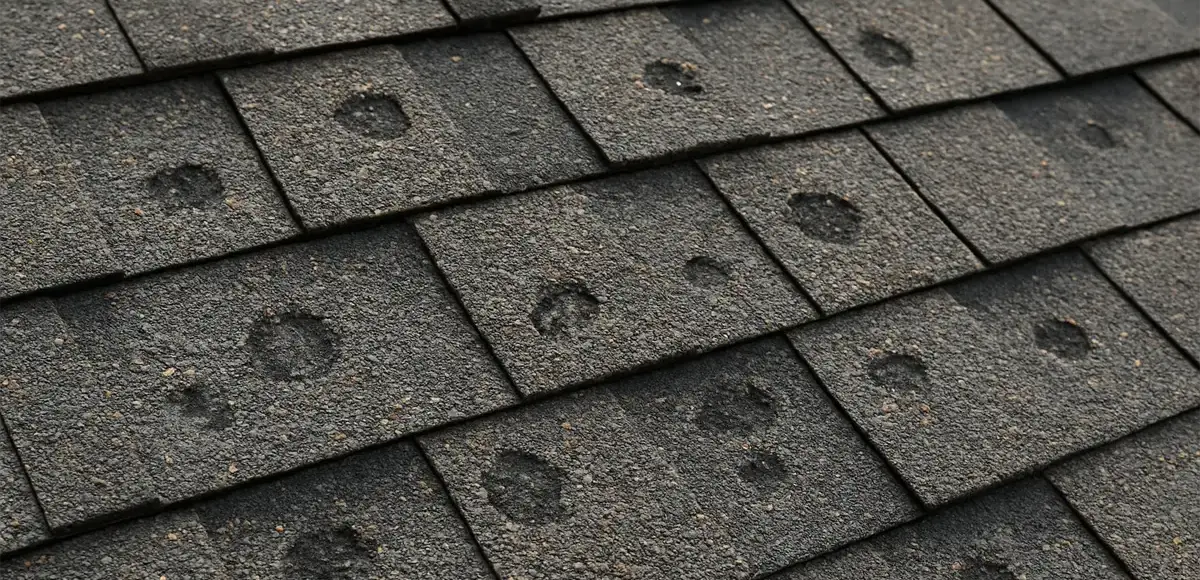
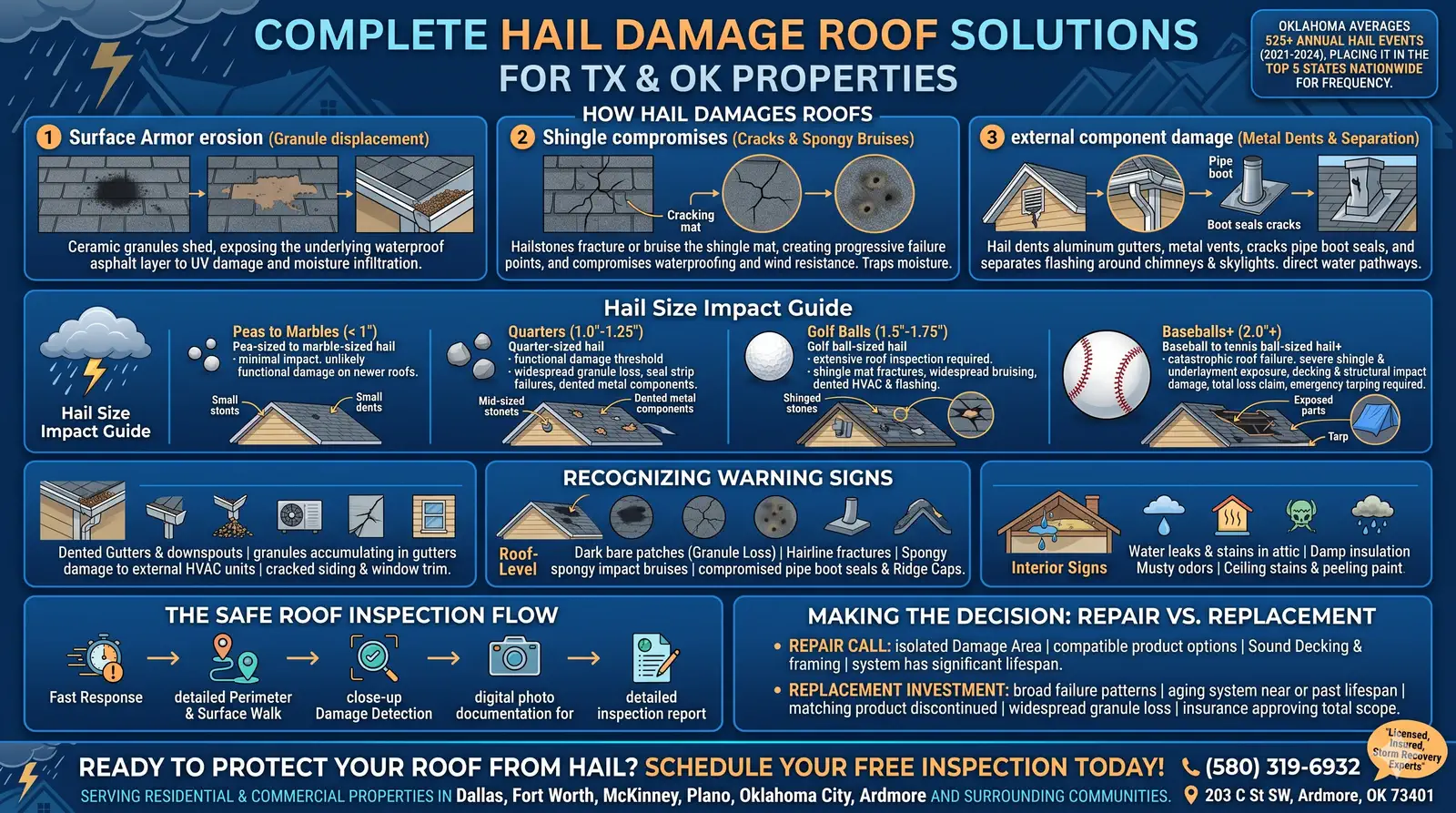
This is the most common form of hail damage on asphalt shingle roofs, and it is also the most frequently overlooked. Every asphalt shingle is coated with ceramic granules that serve two vital functions: they protect the underlying asphalt layer from ultraviolet radiation, and they provide the first line of defense against water penetration. When hailstones strike the roof, they knock these granules loose, exposing the asphalt substrate beneath. Over time, the exposed areas deteriorate faster, becoming soft and porous, which eventually allows water to reach the underlayment and decking.
You may notice granule loss as dark, irregular patches on your roof surface or as an accumulation of coarse, sand-like material in your gutters and downspouts after a storm. While granule displacement may not cause an immediate leak, it significantly accelerates shingle aging and shortens the remaining useful life of your entire roofing system. The Asphalt Roofing Manufacturers Association (ARMA) identifies granule loss as one of the primary accelerants of premature shingle failure, and insurance companies recognize it as functional damage, making it a valid component of hail damage claims across Texas and Oklahoma.
Shingle Fractures and Cracking
Larger hailstones, generally those one inch in diameter or greater, can crack the fiberglass mat that forms the structural core of an asphalt shingle. These fractures often appear as subtle lines or splits in the shingle surface and may not be visible without close-up inspection. A fractured shingle mat compromises the shingle’s ability to shed water and resist wind uplift, making the affected area vulnerable to both leaks and further wind damage during subsequent storms.
In Ardmore and across southern Oklahoma, hailstones regularly exceed one inch, and events producing two-to-four-inch hail are not uncommon during peak storm season. According to data from the National Oceanic and Atmospheric Administration, Oklahoma has experienced 76 severe storm events exceeding one billion dollars in damage since 1980, with the frequency of these events increasing significantly in recent years. Shingle fractures from these events require prompt professional assessment to prevent compounding damage.
Bruising and Soft Spots
When hailstones strike shingles with enough force to compress the underlying material without necessarily cracking the surface, they create soft spots known as bruises. A bruised shingle feels spongy when pressed, and the damaged area no longer provides the same level of protection as the surrounding material. Bruised areas trap moisture, accelerate granule loss in the impact zone, and progressively weaken until the shingle fails entirely.
Bruising is one of the most difficult forms of hail damage to detect without walking the roof and physically testing individual shingles. This is one of the key reasons Safe Roof recommends a professional roof inspection after any hailstorm, even when the roof appears undamaged from ground level.
Damage to Flashing, Vents, and Gutters
Hail does not only affect shingles. Metal components on and around your roof are also vulnerable. Hailstones dent aluminum gutters, damage soffit vents and ridge vents, crack the boots around plumbing vents, and bend or displace flashing around chimneys and skylights. Dented gutters may not drain properly, leading to water overflow that can damage fascia boards and contribute to foundation erosion. Damaged vent boots and flashing create direct pathways for water to enter the roof system, often resulting in attic leaks that only become apparent during subsequent rainfall.
During every hail damage inspection, Safe Roof assesses all roof-mounted components, not just the shingles, to ensure that every element of your roofing system is accounted for in the damage report and the insurance claim.
Areas We Serve
Licensed Commercial & Residential Roofing Contractor
Trusted and licensed contractor for commercial and residential roofing—quality materials, expert service, and lasting protection guaranteed.
LICENSE NUMBER: 80004931
Hail Size Impact Guide — What Different Hailstone Sizes Do to Roofs in Texas & Oklahoma
Texas and Oklahoma property owners frequently ask how large hail needs to be before it causes real roofing damage, and the answer is smaller than most expect. This table covers the damage profile for each common hailstone size category, using the actual storm sizes our inspectors encounter across the DFW metro and South Oklahoma service area each season.
Hailstone Size | Common Reference | Likely Roof Damage | TX & OK Occurrence |
Under 0.75 inch | Pea-sized | Minimal — unlikely to cause functional shingle damage on newer roofs | Common — occurs during most severe thunderstorm events across both states |
0.75 to 1.00 inch | Marble to dime-sized | Granule displacement on older shingles — accelerates aging on roofs over 10 years old | Very common — DFW metro and South Oklahoma see multiple events per season |
1.00 to 1.25 inch | Quarter-sized | Significant granule loss, seal strip failure on standard architectural shingles — functional damage threshold | Common — occurs multiple times per season across TX and OK hail corridor |
1.50 inch | Ping pong ball | Shingle bruising, fiberglass mat fractures, dented gutters and metal components — typically warrants full inspection and claim | Moderately common — Carter County and Collin County both see events at this size annually |
1.75 inch | Golf ball | Widespread shingle cracking, damaged flashing, dented HVAC equipment — replacement often warranted | Occasional — major spring storm events across both states regularly produce this size |
2.00 inch | Hen egg | Severe shingle cracking, underlayment exposure, structural component damage — Class 4 IR shingles begin to show performance advantage | Less frequent but significant — produces major insurance claims across TX and OK when it occurs |
2.50 to 3.00 inch | Baseball to tennis ball | Catastrophic shingle damage, decking exposure, structural impact — full replacement virtually certain | Rare but documented in both states — produces total loss claims across affected neighborhoods |
3.00 inch+ | Baseball or larger | Complete roof system failure, structural damage possible — emergency tarping required | Rare — most severe TX and OK hail events on record — produces widespread neighborhood claims |
Signs Your Roof Has Hail Damage in Texas & Oklahoma
After a hailstorm across the DFW metro or South Oklahoma, homeowners should check for the following indicators. Some signs are visible from the ground, others require a trained inspector on the roof surface to identify accurately.
Ground-Level Signs
- Granule accumulation in gutters and downspouts — Shingle granules that look like coarse, dark sand collecting in gutters or at the base of downspouts indicate hail has knocked the protective surface layer off shingles across the roof.
- Shingle material on the ground — Pieces of cracked or dislodged shingle around the perimeter of your home indicate direct impact damage to the roof surface.
- Dented metal gutters or downspouts — Hail leaves distinctive circular dents in aluminum or steel gutters, if gutters are dented, shingles above them almost certainly absorbed impact as well.
- Damage to outdoor HVAC equipment — Dented or damaged air conditioning units, vents, and exposed metal equipment confirm hail size and intensity, a strong indicator that the roof sustained functional damage.
- Cracked siding or window trim — Impact damage to siding, screens, and trim indicates hailstones large enough to cause roof bruising and granule loss across all exposed surfaces.
Roof-Level Signs — What a Safe Roof Inspector Checks
- Dark spots or bare patches on shingles — Areas where granules have been knocked away exposing the dark asphalt substrate beneath, one of the most common functional hail damage indicators across Texas and Oklahoma.
- Hairline cracks in shingle surfaces — Micro-fractures in the fiberglass mat that are invisible from the ground but compromise the shingle’s waterproofing, detectable only through close-up inspection by a trained professional.
- Soft or spongy areas on shingles — Bruising beneath the shingle surface where the asphalt mat has been fractured by hail impact, identified by pressing on the shingle surface during inspection.
- Dented or displaced flashing — Metal flashing around chimneys, vents, and roof-to-wall transitions that shows circular impact marks or separation from the substrate, a direct water entry risk.
- Cracked pipe boot seals — Rubber pipe boot seals that have cracked or separated from the pipe under hail impact, among the most common post-hail leak sources on Texas and Oklahoma residential roofs.
- Dented or cracked ridge caps — Ridge cap shingles along the highest and most exposed line of the roof that show impact cracking or granule loss, frequently the first component to show visible hail damage.
Interior Signs — Indicators That Hail Has Compromised Your Roof
- New water stains on ceilings or walls — Staining that was not present before the storm indicates active moisture intrusion through a compromised roof component, schedule an inspection immediately.
- Damp spots or standing water in the attic — Moisture in the attic space after a hail event confirms a breach in the roofing system that requires prompt roof inspection and leak detection.
- Musty odors that were not present before the storm — A new musty smell indicates moisture has entered the roof system and begun supporting mold or mildew growth in insulation or framing.
- Peeling or bubbling paint on upper-story ceilings — Paint failure near rooflines indicates trapped moisture from above, a sign that water infiltration has been ongoing since the storm event.
If you notice any of these indicators, do not delay. Contact Safe Roof at (580) 319-6932 to schedule a free inspection. Early detection and documentation are critical for both preventing further damage and supporting a successful insurance claim.
Why Choose Safe Roof
- Permanent Local Presence — Safe Roof is based in Ardmore, OK and serves Texas and Oklahoma year-round, not a storm-chasing crew that arrives after a hail event and disappears once demand drops. We are accountable to every property owner we work with long after the job is complete.
- Fast Post-Hail Response — After major hail events across the DFW metro, Collin County, Oklahoma City, and South Oklahoma, Safe Roof prioritizes active hail damage calls, getting inspectors on-site quickly before interior damage compounds and before scheduling backlogs develop.
- Technical Hail Damage Expertise — Our inspectors are trained to identify functional hail damage, bruising, granule loss patterns, fractured fiberglass mats, and compromised seal strips — that untrained visual inspections from the ground consistently miss.
- Insurance Documentation Standard — Every Safe Roof hail damage inspection produces a photo-documented report formatted to the standard carriers and adjusters require, covering all 15 critical checkpoints with measurements and damage location mapping.
- Code Upgrade Identification — Safe Roof documents the scope items that underpaid hail estimates consistently miss, drip edge, starter strips, decking replacement, ridge cap, and ventilation upgrades, on every claim submission.
- Class 4 Upgrade Expertise — When replacement is warranted, Safe Roof helps property owners evaluate upgrading to Class 4 impact-resistant shingles or metal roofing and provides the manufacturer certification your carrier needs to apply the insurance premium discount.
- Honest Repair vs. Replacement Assessment — Safe Roof never pushes full replacement when targeted roof repair will genuinely solve the problem, and never patches over damage that warrants more comprehensive work. The documented findings drive the recommendation.
Our Hail Damage Roof Repair Process
Safe Roof follows a thorough, systematic approach to hail damage restoration that protects your home and supports your insurance claim at every step.
Comprehensive Inspection and Documentation
Our process begins with a detailed inspection of your entire roofing system. Trained inspectors walk the roof systematically, checking every plane, every transition point, and every component. We photograph and document every instance of hail damage, granule loss, fractures, bruising, dented flashing, and damaged accessories, using a format that meets insurance documentation standards. This inspection report becomes the foundation of your insurance claim and ensures that nothing is missed.
Insurance Coordination
Once the inspection is complete and damage is confirmed, Safe Roof helps you navigate the insurance claims process. We prepare your claim documentation, review your policy terms with you to ensure you understand your coverage, and meet the insurance adjuster on-site to walk through the damage point by point. Our goal is to make sure the adjuster’s scope of loss reflects the full extent of the hail damage, not just the most visible issues.
Professional Repair or Replacement
Depending on the extent of the damage, your roof may need targeted repairs or a complete roof replacement. Localized hail damage affecting a limited area can often be addressed by replacing the damaged shingles and resealing affected flashing. When hail damage is widespread across multiple roof planes, a full replacement is typically the more protective and cost-effective solution.
Safe Roof carries Owens Corning as our primary product line, giving homeowners access to shingle options that are specifically engineered for impact resistance. Upgrading from standard 3-tab shingles to architectural shingles or luxury shingles rated for Class 4 impact resistance can dramatically improve your roof’s ability to withstand future hailstorms. Many insurers also offer premium discounts for homes with impact-resistant roofing installed, making the upgrade a smart investment beyond just storm protection.
Final Walkthrough and Documentation
After repairs or replacement are completed, Safe Roof conducts a final quality walkthrough to ensure every aspect of the work meets our standards. We provide completion documentation, including photos and final invoices, that you submit to your insurance company to release any withheld recoverable depreciation (for RCV policies). The Oklahoma Insurance Department requires that repairs on replacement cost policies be completed within six months of the loss date, so our team works efficiently to keep your project on schedule.
Types of Hail Damage Safe Roof Inspects Across Texas & Oklahoma
Hail damages roofing systems in multiple distinct ways, and each damage type requires a different inspection approach and documentation standard to support an insurance claim. This table covers every hail damage type our inspectors assess on residential and commercial roofs across our Texas and Oklahoma service area, what it looks like, and why it matters for both repair scope and insurance documentation.
Damage Type | What It Looks Like | How It Is Identified | Why It Matters for TX & OK Claims |
Granule Displacement | Dark bare patches on shingle surface — granules in gutters and downspouts | Visual inspection of roof surface and gutter accumulation | Functional damage — exposes asphalt substrate to UV degradation and moisture infiltration |
Shingle Mat Fracture | Hairline cracks in shingle surface — often invisible from ground level | Close-up roof surface inspection — may require flex test | Compromises waterproofing and wind uplift resistance — covered functional damage in most TX and OK policies |
Shingle Bruising | Soft or spongy area when pressed — depression visible in certain lighting | Physical testing with spud tool or hand pressure during roof walk | Covered functional damage — progressive failure point that worsens through subsequent TX and OK storm seasons |
Seal Strip Failure | Shingle lifts at edge when tested — adhesive no longer bonding | Physical tab-lift test during roof walk | Creates wind uplift vulnerability for next storm event — documented as functional damage |
Flashing Denting and Displacement | Circular dent marks on metal flashing — separation from substrate | Visual inspection of all transition and penetration flashing | Direct water entry risk — frequently missed in standard adjuster estimates |
Gutter Denting | Circular impact marks on aluminum or steel gutters | Visual ground-level and roof-level assessment | Confirms hail size and intensity — supports broader shingle damage claim |
Ridge Cap Damage | Cracked or granule-depleted ridge cap shingles | Roof-level visual inspection along ridge line | Most wind-exposed component — functional damage at ridge compromises full roof system |
Pipe Boot Cracking | Cracked or separated rubber boot around plumbing penetrations | Close-up inspection at each penetration point | Common post-hail leak source — omitted from many TX and OK adjuster estimates |
HVAC Unit Denting | Circular impact marks on condenser fins and housing | Ground-level and roof-level assessment of mechanical equipment | Confirms storm severity — supports broader damage claim across all roof components |
Decking Moisture Damage | Soft spots, delamination, or discoloration on roof sheathing | Post-tear-off panel assessment | Covered scope when caused by storm-related water intrusion — frequently excluded from initial estimates |
Hail Damage Roof Repair vs. Full Replacement — How to Decide
One of the most important questions Texas and Oklahoma homeowners face after a hailstorm is whether their roof needs a targeted repair or a complete replacement. Safe Roof provides honest recommendations based on actual roof condition, never pushing replacement when repair will genuinely solve the problem, and never patching over damage that warrants more comprehensive work.
When Repair Is the Right Call
- Hail damage is confined to a limited area — When damage is isolated to one or two roof planes and the remainder of the roof is in sound condition with significant useful life remaining, targeted roof repair is the most cost-effective path.
- Matching shingles are available — If the damaged shingles can be replaced with a product that matches the existing installation in profile, color, and performance, a repair restores full protection without the cost of a complete tear-off.
- Structural components beneath are sound — When a close-up inspection confirms the decking, underlayment, and framing beneath the damaged area are intact and undamaged, repair addresses the problem at the right scope.
- Roof has significant remaining lifespan — A roof under 15 years old with localized hail damage and otherwise sound condition is a strong repair candidate, the remaining system life supports the value of targeted work.
When Replacement Is the Better Investment
- Hail damage covers the majority of the roof surface — When impact bruising, granule loss, and compromised seal strips are present across multiple roof planes, the system is failing broadly, continued repair becomes uneconomical and a full roof replacement is more cost-effective.
- Existing roof was near the end of its lifespan before the storm — A roof at or past 20 years old in Texas or Oklahoma that has absorbed multiple hail seasons is typically a replacement candidate even if the current storm damage appears isolated.
- Matching shingles are no longer available — When the installed product has been discontinued, replacement is often the only path to a consistent, warranted roofing system, and may qualify for an upgrade approval from your insurance carrier.
- Widespread granule loss even without visible cracking — Significant granule loss across the roof surface reduces remaining lifespan to the point where replacement delivers better long-term value than repair, even if no shingles are visibly cracked.
- Insurance carrier approves full replacement scope — When Safe Roof’s documentation confirms damage covers 25 percent or more of the roof surface, most Texas and Oklahoma carriers approve full replacement over partial repair. When replacement is the right call, Safe Roof helps you select materials, from shingle roof replacement options to metal roofing, that match your budget and long-term protection goals.
What Our Customers Say
Why Property Owners Need Hail Damage Inspections — Even When the Roof Looks Fine
One of the most dangerous aspects of hail damage is how invisible it can be from the ground. A roof that appears perfectly intact to the homeowner standing in the driveway may have sustained hundreds of impact points across its surface, each one compromising the shingle’s long-term performance. Granule loss, in particular, creates no visible change from street level but exposes the shingle substrate to UV degradation and moisture infiltration that worsens steadily over months and years.
In the Oklahoma & Texas climate, where intense heat follows spring storms, this hidden damage accelerates even faster. UV exposure on granule-depleted shingles can reduce their effective lifespan by years, turning what would have been a covered insurance repair into an uncovered maintenance issue if the damage goes undetected and the filing window passes.
Safe Roof offers free post-storm roof inspections to every homeowner in the Ardmore area. There is no cost and no obligation. If we find hail damage, we provide a complete documentation package that supports your insurance claim. If we do not find damage, we tell you honestly and you have peace of mind knowing your roof is sound.
Proudly Serving Texas & Oklahoma With Expert Hail Damage Roof Repair Services
Safe Roof responds to hail damage roof repair calls across our full Texas and Oklahoma service area, from the spring hail events that sweep through Collin County and the DFW Metroplex, where some of the highest hail frequency rates in the country drive consistent post-storm demand, to the severe hailstorms that track across South-Central Oklahoma each season, where fast inspection response and thorough insurance documentation make the difference between a fully covered repair and a costly out-of-pocket settlement.
Our service areas include: Dallas, Far North Dallas, Fort Worth, Prosper, Celina, Plano, Sherman, McKinney, Oklahoma City, Ardmore and surrounding areas. If you are looking for a broader view of our coverage, then see our full service area page here.
Schedule Your Free Hail Damage Roof Inspection in Texas & Oklahoma Today
Hail damage is rarely visible from the ground, and every rain event after an uninspected hailstorm is an opportunity for water to enter through compromised shingles, broken seal strips, and damaged flashing. The sooner your roof is inspected and documented, the stronger your position for both repairs and any subsequent insurance claim.
Safe Roof serves residential and commercial property owners across Dallas, Fort Worth, McKinney, Plano, Oklahoma City, Ardmore, and surrounding communities. Our licensed inspectors get on-site fast after hail events, document every affected component to insurance standards, and deliver a written assessment before recommending any scope of work.
Call (580) 319-6932, visit our free roof quote page, or reach out through our contact page to schedule your free hail damage roof inspection today.
Frequently Asked Questions
Hailstones as small as one inch can cause functional damage, granule displacement and seal strip failure. Stones of 1.5 inches or larger frequently require shingle replacement. According to NOAA, Texas and Oklahoma rank among the top states nationally for hail frequency, with hailstones well above one inch common across the DFW metro and South Oklahoma each spring and summer.
Most Texas and Oklahoma policies cover hail damage as a named covered peril, but some carry cosmetic damage exclusions, separate wind and hail deductibles, or ACV provisions that significantly affect your payout. Safe Roof helps you document functional damage that falls clearly within your coverage before you file.
Ideally within seven to fourteen days. Most Texas and Oklahoma policies require claims within six to twelve months of the loss date, early inspection documents the damage while the link to the specific storm event is clear and before subsequent weather compounds the initial impact.
In severe cases yes, but more commonly, hail creates conditions that lead to leaks weeks or months later as granule loss and micro-fractures allow gradual moisture penetration. This delayed onset is why a professional roof inspection is critical even when there are no immediate interior signs.
Class 4 is the highest UL 2218 impact resistance rating, shingles that withstand a 2-inch steel ball impact without cracking. Most Texas and Oklahoma carriers offer 15 to 30 percent premium discounts for qualifying Class 4 installations. Safe Roof installs Class 4 architectural shingles and provides the manufacturer certification your carrier requires to apply the discount.
No. Safe Roof provides free, no-obligation roof inspections across our full Texas and Oklahoma service area. If we find damage that warrants a claim, we provide complete photo documentation at no charge. If we do not, we tell you honestly, no pressure, no cost.
Functional hail damage compromises waterproofing, cracked shingle mats, granule loss exposing substrate, broken seal strips, and damaged flashing. Cosmetic damage affects appearance only. Some Texas and Oklahoma policies exclude cosmetic damage, Safe Roof’s inspections specifically document functional damage that falls within covered territory regardless of cosmetic exclusion language.
Safe Roof
Business Hours
Monday: Open 24 hours
Tuesday: Open 24 hours
Wednesday: Open 24 hours
Thursday: Open 24 hours
Friday: Open 24 hours
Saturday: Open 24 hours
Sunday: Open 24 hours
Book a Free Inspection
Our Services
Safe Roof
Business Hours
Monday: Open 24 hours
Tuesday: Open 24 hours
Wednesday: Open 24 hours
Thursday: Open 24 hours
Friday: Open 24 hours
Saturday: Open 24 hours
Sunday: Open 24 hours
Your Elite Residential and Commercial Roofing Team in Texas & Oklahoma
Whether you’re dealing with storm damage, planning a replacement, or just want a professional opinion on your roof’s condition, Safe Roof is ready to help. We serve property owners across Texas and Oklahoma, showing up on time, doing the work right, and standing behind every install with GAF-certified warranty coverage.
Getting an estimate costs nothing and commits you to nothing. We’ll assess your roof, walk you through the findings, and provide a clear written estimate.