Why Choosing the Right Hail Damage Roof Contractor in Texas Could Save You Thousands
Every year after a major hailstorm, two things happen fast in Texas: roofs get damaged, and out-of-state contractors flood local neighborhoods looking for quick payouts. These so-called “storm chasers” knock on doors, promise fast repairs, and pressure homeowners into signing contracts before an insurance adjuster ever sets foot on the property. By the time the work is done — or not done — many homeowners are left with a botched repair, a disputed claim, and no way to track down the contractor who took their money.
Here’s what you need to know right now:
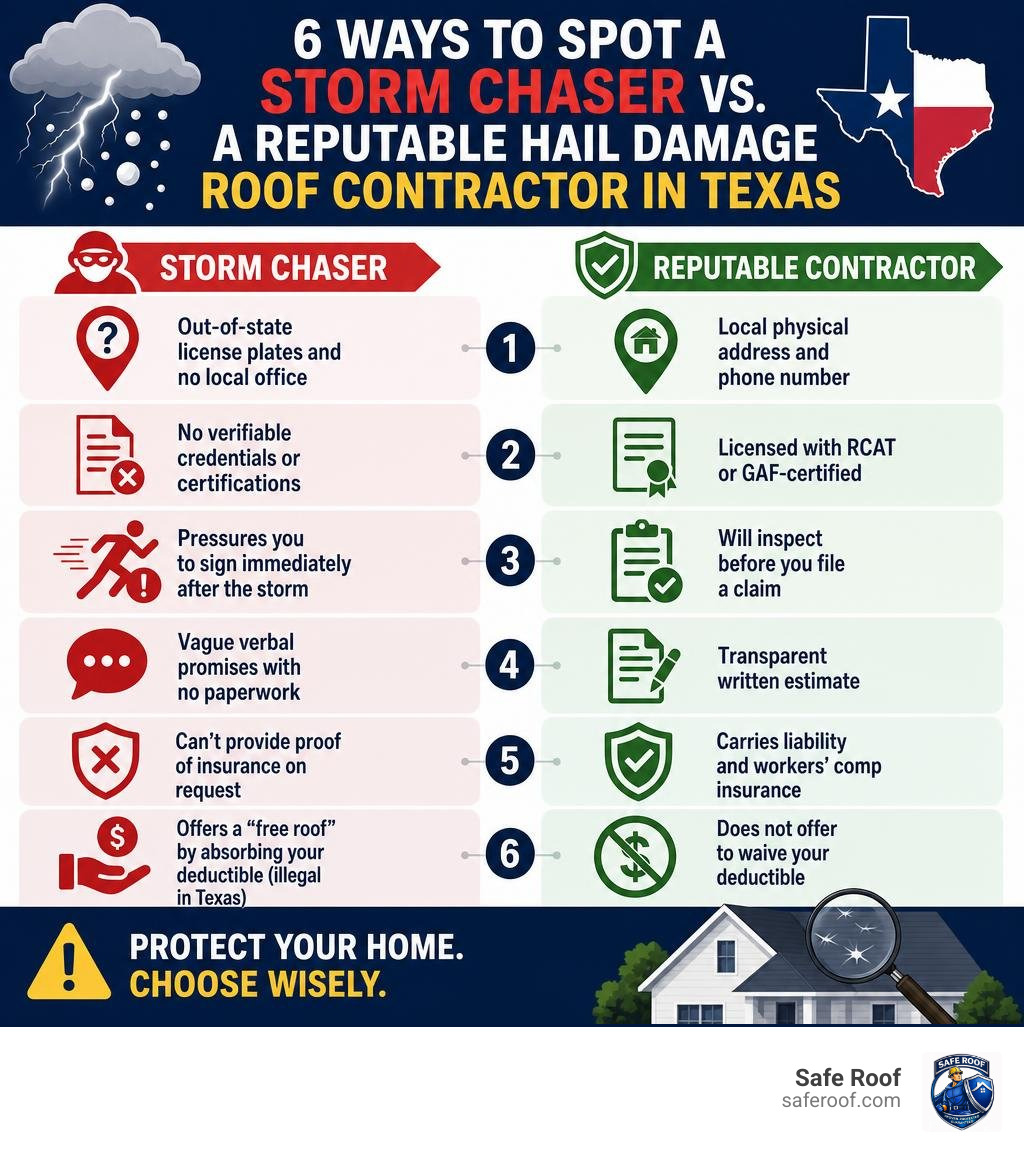
How to quickly identify a reputable hail damage roof contractor in Texas:
| What to Look For | Red Flag to Avoid |
|---|---|
| Local physical address and phone number | Out-of-state license plates and no local office |
| Licensed with RCAT or GAF-certified | No verifiable credentials or certifications |
| Will inspect before you file a claim | Pressures you to sign immediately after the storm |
| Transparent written estimate | Vague verbal promises with no paperwork |
| Carries liability and workers’ comp insurance | Can’t provide proof of insurance on request |
| Does not offer to waive your deductible | Offers a “free roof” by absorbing your deductible (illegal in Texas) |
Texas ranks among the top states for hail insurance claims. Hail of one inch or larger can cause enough granule damage to warrant a full roof replacement — and most Texas homeowner policies require you to file that claim within one year of the storm date. That tight window is exactly what storm chasers exploit.
Safe Roof is a GAF-certified roofing contractor serving homeowners across Texas and Southern Oklahoma — and this guide will help you tell the difference between a contractor who protects your home and one who just sees a payday.
I’m Jacob Ortiz, owner of Safe Roof and a licensed hail damage roof contractor serving Texas and Oklahoma with years of hands-on experience in storm damage restoration and insurance claims support. If you’ve just had a hailstorm roll through your neighborhood, keep reading — what you do in the next few days matters more than most homeowners realize.
Simple guide to hail damage roof contractor Texas:
1. The Anatomy of a Texas Hailstorm: What Happens to Your Roof
When severe weather sweeps through the DFW Metroplex, North Texas, or Southern Oklahoma, the physical impact of hail on your home is immediate and destructive. Hailstones ranging from pea-sized to over four inches fall at terminal velocities, striking your roof with immense force. The structural consequences vary significantly depending on the type of roofing materials installed on your home.
- Asphalt Shingles: The most common sign of hail damage on asphalt shingles is localized granule loss. Mineral granules protect the underlying asphalt mat from harmful ultraviolet (UV) radiation. When hail strikes, it dislodges these granules, leaving dark circular “bruises” or craters. Over time, UV exposure degrades the unprotected asphalt, making the shingles brittle, prone to cracking, and highly susceptible to leaks.
- Metal Roofs: While metal roofing systems are highly durable, they are not immune to storms. Hail impacts leave visible dents and dimples. While minor denting may be purely cosmetic, larger hailstones can warp metal panels, loosen fasteners, tear critical seams, and compromise the structural integrity of the entire roof.
- Tile Roofs: Clay and concrete tiles are rigid and strong, but they are brittle under direct, high-velocity impacts. Hail causes star fractures, cracks, and complete breaks. A single cracked tile allows water to seep directly onto the underlayment, which quickly leads to structural deck rot.
Learn more about Texas roofing services to see how different materials withstand our extreme regional weather.
Why You Need a Certified Hail Damage Roof Contractor Texas
Identifying hail damage is not always straightforward. Many homeowners look up from their driveways, see no missing shingles, and assume their roof survived the storm. This is a costly mistake. Hail damage is rarely visible from the ground, which is why a comprehensive, close-range inspection is critical.
A certified hail damage roof contractor in Texas uses precise criteria to evaluate your roof. We look for soft-metal indicators first. Metal components like aluminum gutters, downspouts, flashing, ridge caps, and roof vents show dents much more clearly than shingles do. If your vents and gutters are bruised, it is a definitive sign that your shingles took a beating too.
Furthermore, professional contractors evaluate wind direction and storm patterns to determine which slopes of your roof sustained the heaviest impacts. We align our findings with HAAG engineering standards, which are the gold standard for damage assessment recognized by major insurance carriers. By documenting the exact size, density, and frequency of hail impacts per “square” (a 10′ x 10′ area of the roof), we compile the undeniable evidence required to support your claim.
If you suspect your home has been hit, do not wait for a leak to appear. Schedule our professional storm damage roofing services for a comprehensive, safety-first assessment.
2. Red Flags: How to Spot Storm Chasers and Door-to-Door Scammers
In the wake of a major storm in Collin County or the wider DFW Metroplex, “storm chasers” descend on affected neighborhoods like clockwork. These are out-of-state, non-local contractors who follow severe weather patterns across the country. They set up temporary operations, collect insurance payouts, perform low-quality, rushed roof installations, and vanish before the next season arrives.
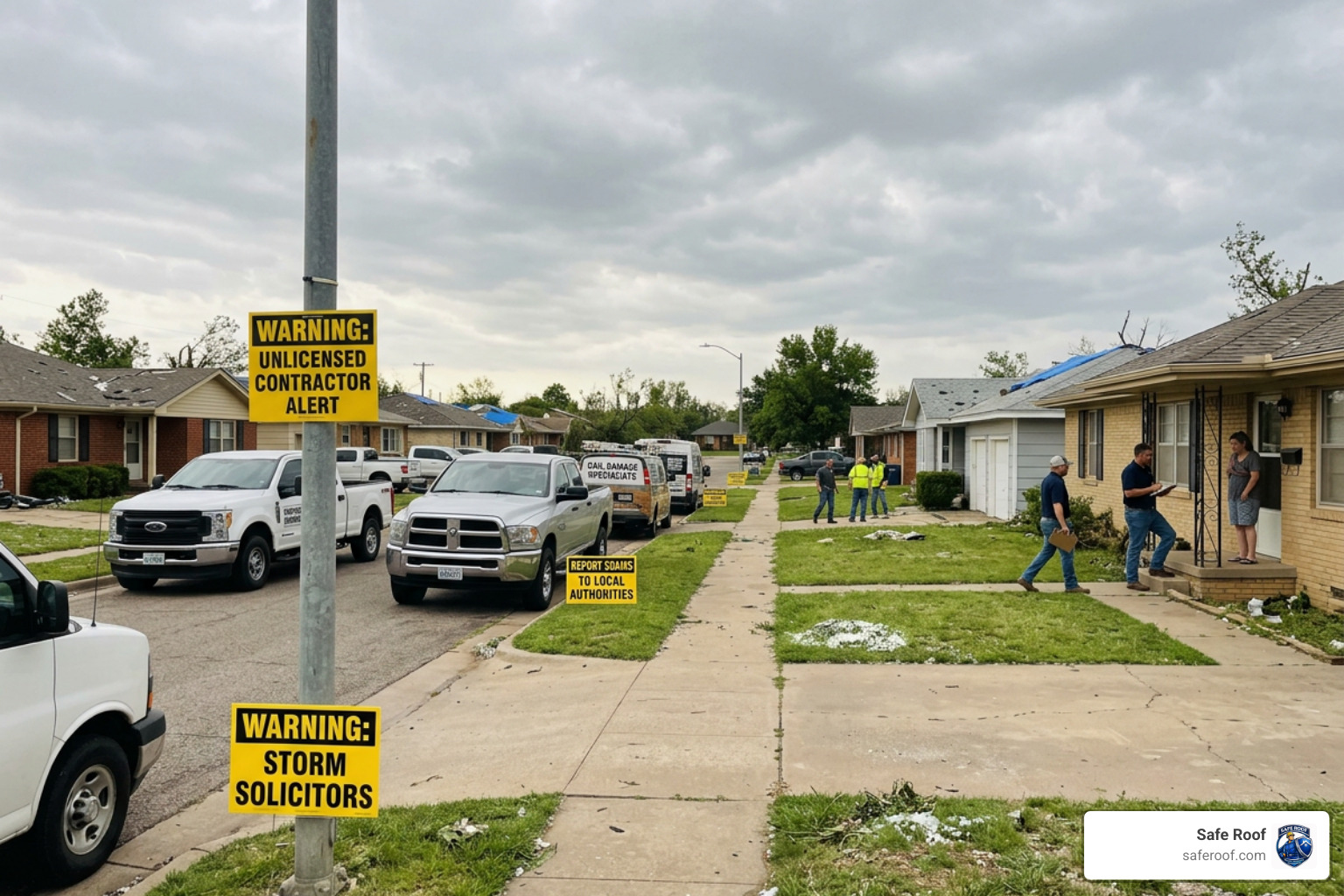
To protect your home and your wallet, watch out for these critical red flags:
- Out-of-State Plates and Non-Local Phone Numbers: If the trucks parked in your neighborhood have out-of-state license plates, or if the salesperson’s business card features a non-local area code, they are likely storm chasers.
- High-Pressure Sales Tactics: Scammers rely on urgency. They will tell you that “your neighbors are already signing up” or that you must “act today to secure a spot.”
- Unsolicited Door-to-Door Inspections: Reputable local contractors rarely knock on doors uninvited after a storm. If someone shows up at your door offering a “free, immediate inspection,” be highly cautious.
- Deductible-Eating Schemes: If a contractor promises to “waive,” “absorb,” or “rebate” your insurance deductible, walk away. This is not a discount; it is a class A misdemeanor under Texas law.
The Danger of Signing Contingency Agreements Immediately
One of the most common traps used by door-to-door scammers is the “contingency agreement.” The salesperson will present this as a harmless document, claiming it simply gives them permission to inspect your roof or speak with your insurance adjuster on your behalf.
In reality, many of these documents are legally binding contracts. By signing, you may be agreeing to hire that specific contractor to replace your roof if your insurance claim is approved. If you later decide to use a reputable, local company, the storm chaser may threaten legal action or demand a steep “cancellation fee” (often 10% to 20% of the total claim value).
Before signing any paperwork, read our Guide to insurance approved roof contractors to learn how to keep control of your claim and protect your legal rights.
3. The Post-Storm Action Plan: Documenting Damage for Insurance
If a hailstorm has recently impacted your area, taking systematic, organized steps will drastically improve your chances of a fully approved insurance claim. Do not rely on your insurance company’s adjuster to find every piece of damage. You must build a solid, documented case.
Here is your immediate, step-by-step post-storm action plan:
- Safety First: Never climb onto your roof yourself, especially after a storm when shingles may be loose, wet, or structurally compromised.
- Document the Date and Time: Note the exact date and time the storm hit. Insurance claims require a specific “date of loss.”
- Take Ground-Level Photos: Walk the perimeter of your home. Take clear, high-resolution photos of hail accumulated on the ground, dented window screens, damaged siding, chipped paint, and bruised garage doors.
- Check Your Gutters and Downspouts: Look for heavy accumulations of shingle granules at the exit of your downspouts. This is a primary indicator of severe shingle erosion.
- Inspect Your Attic: Go into your attic with a flashlight. Look for active water drips, damp insulation, or dark water stains on the underside of your roof decking.
To understand why a professional assessment is vital, consider how a homeowner’s visual check compares to a professional inspection:
| Feature / Area Checked | Homeowner Self-Inspection (Ground Level) | Professional Hail Damage Inspection |
|---|---|---|
| Roof Surface & Shingles | Misses subtle bruising, micro-fractures, and granule loss. | Close-up physical assessment using HAAG standards. |
| Soft Metals & Vents | Can identify large dents on gutters but misses high vents. | Detailed mapping of impact marks on all metal penetrations. |
| Collateral Damage | Identifies broken screens and dented siding. | Documents comprehensive property damage to support the claim. |
| Attic & Underlayment | Checks for active leaks only. | Evaluates structural integrity, deck rot, and latent moisture. |
| Documentation | Cell phone photos of ground-level damage. | Comprehensive digital damage reports with drone or high-res imagery. |
How a Professional Roofer Navigates the Adjuster Meeting
Filing a claim is only the first step; getting it approved for the correct scope of work is where many homeowners struggle. Insurance adjusters work directly for the insurance company, and their goal is to minimize the carrier’s financial liability. They may overlook bruised shingles, attribute storm damage to “wear and tear,” or approve a minor repair when a full replacement is structurally necessary.
This is why having your roofing contractor present during the adjuster’s physical inspection is invaluable. When we attend the adjuster meeting, we act as your expert advocate. We walk the roof alongside the adjuster, pointing out soft-metal damage, shingle bruising, and structural issues that might otherwise be missed.
We speak the adjuster’s language, utilizing industry-standard estimating software like Xactimate to ensure that the scope of work is accurate, transparent, and complete. If the initial payout is insufficient, we compile and submit detailed line-item supplements to secure the additional funding required to restore your home properly. Get expert insurance claims assistance today to ensure your roof is fully and fairly covered.
4. Understanding the Texas Insurance Claim Timeline and Costs
Navigating the financial side of a roof replacement can feel overwhelming. In Texas, the vast majority of homeowner insurance policies require you to file a hail or wind damage claim within one year of the storm event. While some carriers allow up to 1.8 years, waiting weakens your claim position, as insurers may argue that the damage occurred during a subsequent, undocumented storm or was caused by neglect.
When filing a claim, it is crucial to understand your policy type:
- Replacement Cash Value (RCV): An RCV policy is the most comprehensive. The insurer pays the full cost to repair or replace your damaged roof, minus your deductible. Payments are typically split into two checks: the initial Actual Cash Value (ACV) payment, and a second check for “recoverable depreciation” once the work is completed and invoiced.
- Actual Cash Value (ACV): An ACV policy only pays for the depreciated value of your roof based on its age and pre-storm condition. If you have a 15-year-old roof under an ACV policy, your payout will be significantly lower, leaving you to cover the remaining balance out of pocket.
In terms of out-of-pocket expenses, homeowners are legally responsible for paying their insurance deductible. Typical residential roof replacement costs in Texas range between $10,000 and $30,000, depending on the size of your home, the pitch of your roof, and the materials chosen. Minor repairs can run anywhere from $150 to $1,500.
Why Waiting to Hire a Hail Damage Roof Contractor Texas Accelerates Roof Decay
Some homeowners choose to delay roof repairs, especially if they do not see active leaks inside their living spaces. In Texas, this delay is highly destructive. Our climate is characterized by extreme summer heat, with attic and rooftop temperatures regularly exceeding 140°F.
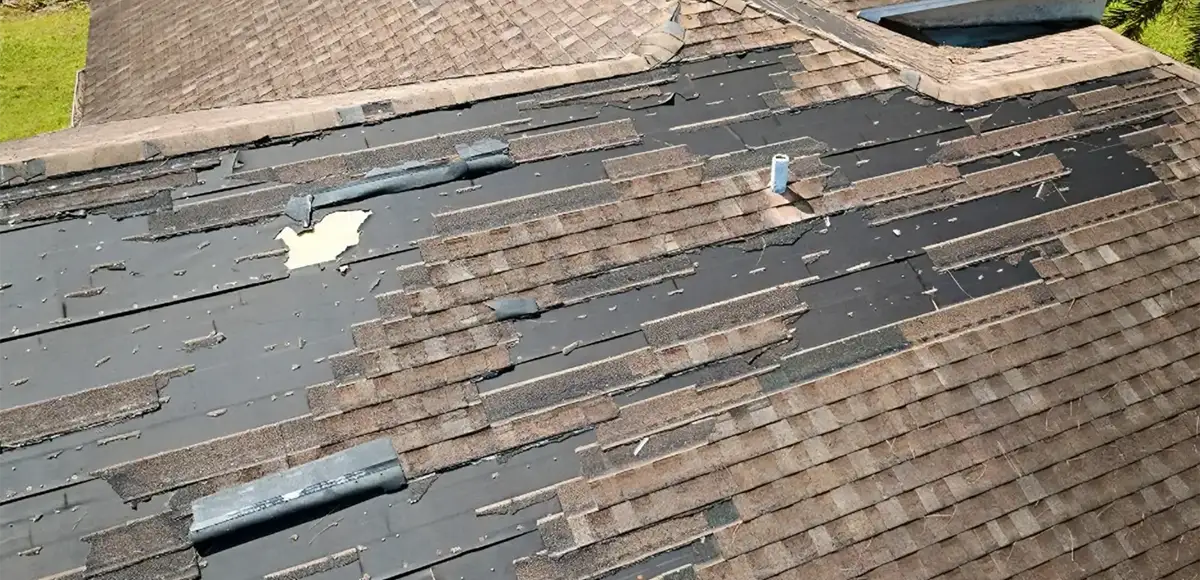
When hail strikes a shingle, it creates a micro-fracture in the asphalt mat. As the roof bakes under the intense Texas sun, the damaged shingles undergo “thermal shock.” The constant expansion and contraction cause those tiny fractures to widen rapidly. Within a few months, water begins to seep through the compromised shingles, rotting the wooden roof decking, destroying attic insulation, and fostering toxic mold growth.
What could have been a straightforward, insurance-covered roof replacement can quickly escalate into thousands of dollars in uncovered structural and interior repairs. To prevent this, follow our step-by-step hail damage roof restoration guide to protect your home’s structural integrity and long-term value.
5. How to Choose a Reputable Hail Damage Roof Contractor Texas
Because Texas does not require a state license for roofing contractors, the market is flooded with uncertified, uninsured individuals. To protect your home, you must take the time to thoroughly vet any contractor you consider hiring.
First and foremost, look for a contractor with a permanent, physical local address and a strong reputation in your community. Whether you are looking for Dallas roofing experts or need a trusted team for Oklahoma roofing projects, working with a local company ensures they will be around to honor their workmanship warranties for years to come.
Always verify credentials through the Roofing Contractors Association of Texas (RCAT). While the state does not mandate licensing, RCAT offers a voluntary licensing program that requires contractors to pass rigorous examinations, maintain continuous education, and demonstrate financial stability.
Essential Credentials and Warranties to Verify
When hiring a contractor to repair or replace your hail-damaged roof, always ask for proof of the following credentials:
- GAF Master Elite Certification: This designation is held by fewer than 2% of all roofing contractors nationwide. It indicates that the contractor is fully licensed, adequately insured, possesses a proven reputation in their community, and is committed to ongoing professional training.
- Enhanced Manufacturer Warranties: Only certified contractors can offer enhanced warranties, such as the GAF Golden Pledge. This covers both manufacturing defects and the contractor’s workmanship for up to 50 years, backed directly by the manufacturer.
- Comprehensive Insurance: Ensure the contractor carries active general liability insurance (to protect your property from accidental damage) and workers’ compensation insurance (to protect you from liability if a worker is injured on your property).
Learn more about the benefits of working with certified installers by exploring our comprehensive storm damage roofing services.
Frequently Asked Questions About Texas Hail Damage
How long do I have to file a hail damage claim in Texas?
In Texas, most insurance policies require you to file a windstorm or hail damage claim within one year of the date of the storm event, though specific policy terms may vary. If you suspect your home has sustained storm damage, explore your immediate roof repair options to address any issues before your filing window closes.
Can I get my roof replaced for free or have my deductible waived?
No. Under Texas Law House Bill 2102, it is illegal for a roofing contractor to waive, absorb, or rebate an insurance deductible. Homeowners must pay their full deductible, and contractors who offer to “eat” the deductible are committing class A misdemeanor insurance fraud. For legal compliance details, review the official Texas Department of Insurance deductible regulations.
What is the difference between a standard inspection and a professional hail inspection?
A standard inspection looks for obvious leaks, while a professional hail inspection utilizes digital analysis to identify latent damage like bruised shingles, micro-fractures, and soft-metal impacts that lead to premature roof failure. If your roof has been exposed to severe weather, schedule a professional roof replacement or a detailed storm inspection with our certified team.
Conclusion
When a severe hailstorm hits your Texas home, the actions you take in the subsequent days will dictate the safety, structural integrity, and financial security of your property. Do not fall victim to high-pressure door-to-door sales scams or out-of-state storm chasers who offer empty promises and illegal deductible schemes.
By choosing a reputable, local, GAF-certified contractor, you ensure that your roof is evaluated using HAAG engineering standards, your insurance claim is documented with indisputable evidence, and your home is restored using high-quality materials backed by industry-leading 50-year warranties.
At Safe Roof, we are proud to serve communities across Texas and Southern Oklahoma with honest inspections, expert craftsmanship, and dedicated insurance advocacy.
Don’t let storm damage compromise your home’s value. Get professional insurance claims assistance today to schedule your comprehensive, stress-free roof inspection.