What Is Siding Installation and Why Does It Matter for Your Home?
Siding installation is the process of applying an exterior cladding material to the outside walls of your home to protect it from weather, improve energy efficiency, and boost curb appeal. Working with a professional exterior restoration contractor ensures that your home’s envelope is completely sealed against the elements.
Here’s what you need to know at a glance:
| Topic | Quick Answer |
|---|---|
| Most popular materials | Vinyl, fiber cement, engineered wood, composite |
| Average lifespan | Vinyl: 20–30 years / Fiber cement: 30–50 years |
| Key benefit | Protects against wind, rain, hail, pests, and fire |
| DIY or professional? | Professional installation recommended for best results |
| Cost range | Varies by material, home size, location, and season |
Your siding does more than make your home look good. It is your home’s first line of defense against the elements. In storm-prone regions like Texas and Oklahoma, that protection is not optional — it is essential. Hail, high winds, and heavy rain can tear through aging or improperly installed siding, leading to water intrusion, mold, and costly structural damage.
New siding also directly impacts your home’s market value, energy bills, and even your homeowner’s insurance premiums. Choosing the right material and installing it correctly makes a significant difference in how well it holds up over time.
At Safe Roof, we handle siding installation as part of our full exterior restoration services, giving homeowners across Southern Oklahoma and North Texas a one-stop solution after storm damage or normal wear and tear. I’m Jacob Ortiz, owner of Safe Roof, and over the years I’ve overseen hundreds of siding projects alongside roofing replacements, giving me a understanding of how proper installation protects homes in some of the harshest weather conditions in the country. In this guide, I’ll walk you through everything — from picking the right material to avoiding the most common installation mistakes.
Comparing Siding Materials: Cost, Durability, and Performance
Selecting the right siding material is the most important decision you will make for your home’s exterior. As of May 2026, homeowners have access to highly advanced materials that balance cost, durability, aesthetics, and maintenance.
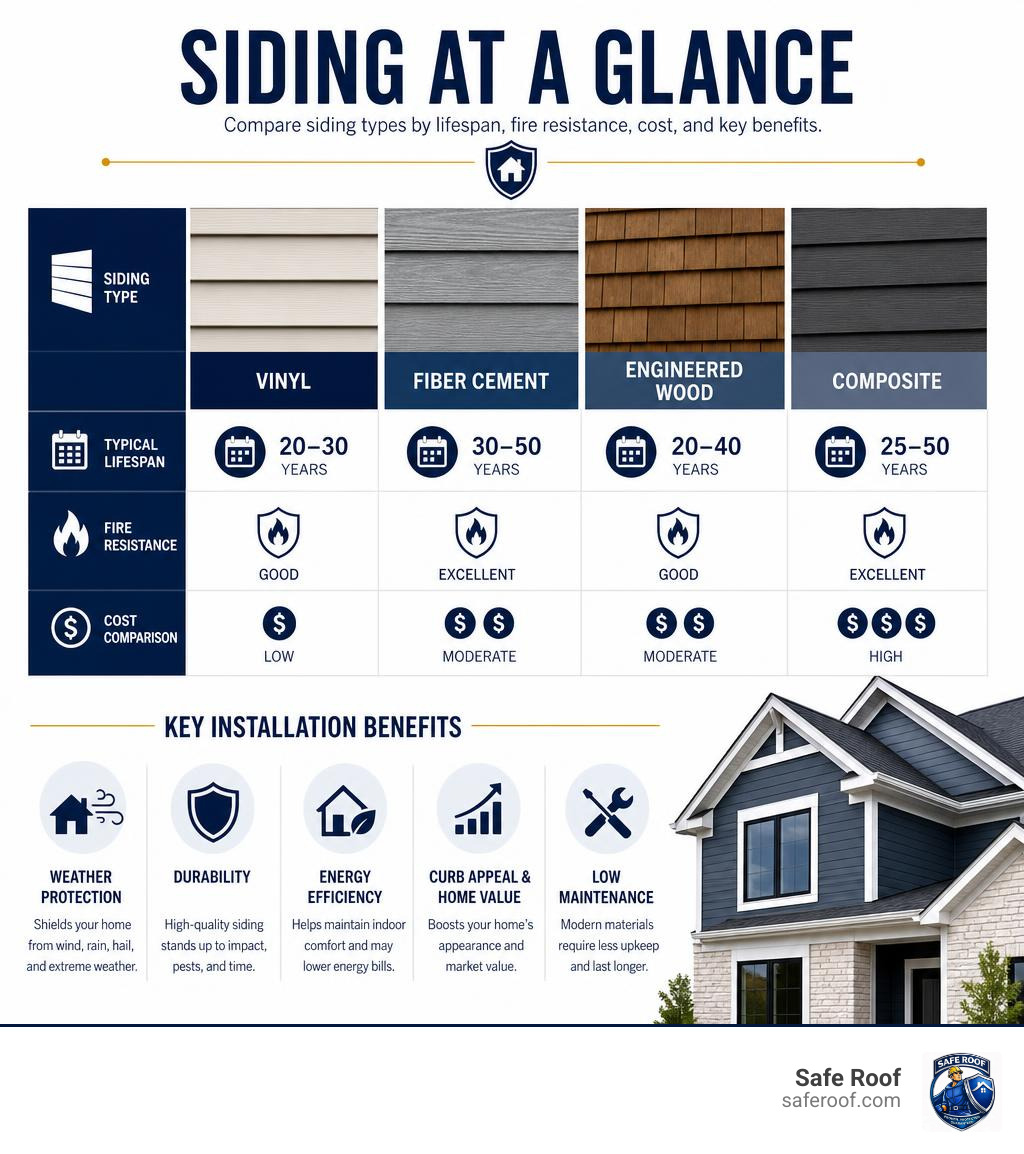
To help you make an informed choice, let’s look at how the top five siding materials compare side-by-side:
| Material | Average Lifespan | Relative Cost | Maintenance Level | Key Strengths | Key Weaknesses |
|---|---|---|---|---|---|
| Vinyl Siding | 20–30 Years | $ (Lowest) | Very Low | Cost-effective, easy to clean, highly flexible | Vulnerable to melting, wind damage, and cracking under impact |
| Fiber Cement | 30–50 Years | $$$ | Low to Moderate | Fire-resistant, rot-resistant, extremely durable | Heavy, expensive to install, requires occasional painting |
| Engineered Wood | 30–50 Years | $$ | Low to Moderate | High impact resistance, natural wood look, easy to install | Requires proper edge sealing to prevent moisture absorption |
| Composite Siding | 25–40 Years | $$$ | Very Low | Highly eco-friendly, fade-resistant, low maintenance | Higher upfront material cost |
| Traditional Wood | 15–30 Years | $$$$ | High | Unmatched natural beauty, premium historic appeal | Susceptible to rot, pests, and fire; requires frequent sealing |
Vinyl Siding: The Budget-Friendly Standard
Vinyl siding is the most common exterior cladding in North America, primarily because it is roughly one-third the cost of fiber cement siding. It is incredibly low-maintenance, requiring nothing more than an annual washdown with a garden hose to look its best.
However, vinyl has some notable limitations. It is up to five times thinner than fiber cement siding, making it susceptible to cracking during severe North Texas hail storms. Additionally, vinyl is vulnerable to melting caused by direct flames, nearby barbecue grills, and intense solar heat reflected off modern low-emissivity (Low-E) windows.
Fiber Cement Siding: The Heavy-Duty Shield
Fiber cement siding (such as James Hardie) is a premium mixture of cement, sand, and cellulose fibers. It is incredibly thick, heavy, and durable, boasting a lifespan of 30 to 50 years.
Its standout feature is its safety profile: fiber cement siding is completely fire-resistant. It will not ignite or act as fuel for a fire when exposed to a direct flame. For homeowners in dry, fire-prone areas of Oklahoma and Texas, this offers invaluable peace of mind. The main trade-offs are the higher upfront material cost and the labor-intensive installation process.
Engineered Wood: The Toughest Performer
Engineered wood siding, such as LP SmartSide, combines wood strands or fibers with water-resistant resins and zinc borate (a natural pest and rot preventer). It offers the gorgeous warmth of real wood but with vastly superior strength and impact resistance.
Engineered wood is significantly lighter than fiber cement, making it faster to install while still offering incredible wind and hail resistance. To ensure its long-term performance and preserve its warranty, installers must carefully follow the official LP SmartSide Application Instructions, which require sealing all field-cut edges and maintaining proper ground clearances.
Composite Siding: The Eco-Friendly Innovator
Modern composite siding (such as NewTechWood) is manufactured using up to 95% recycled materials, including reclaimed wood fibers and recycled plastic bottles. It utilizes advanced co-extruded protective caps to shield the core from moisture, fading, and scratches.
Composite siding is highly sought after for modern, energy-efficient “smart homes” due to its durability and low environmental footprint.
Key Steps in Preparing Your Home for Siding Installation
A beautiful siding job is only as good as the preparation work underneath it. If you install brand-new siding over a rotting, damp, or uneven wall, you are simply masking a problem that will eventually destroy your home’s structure.
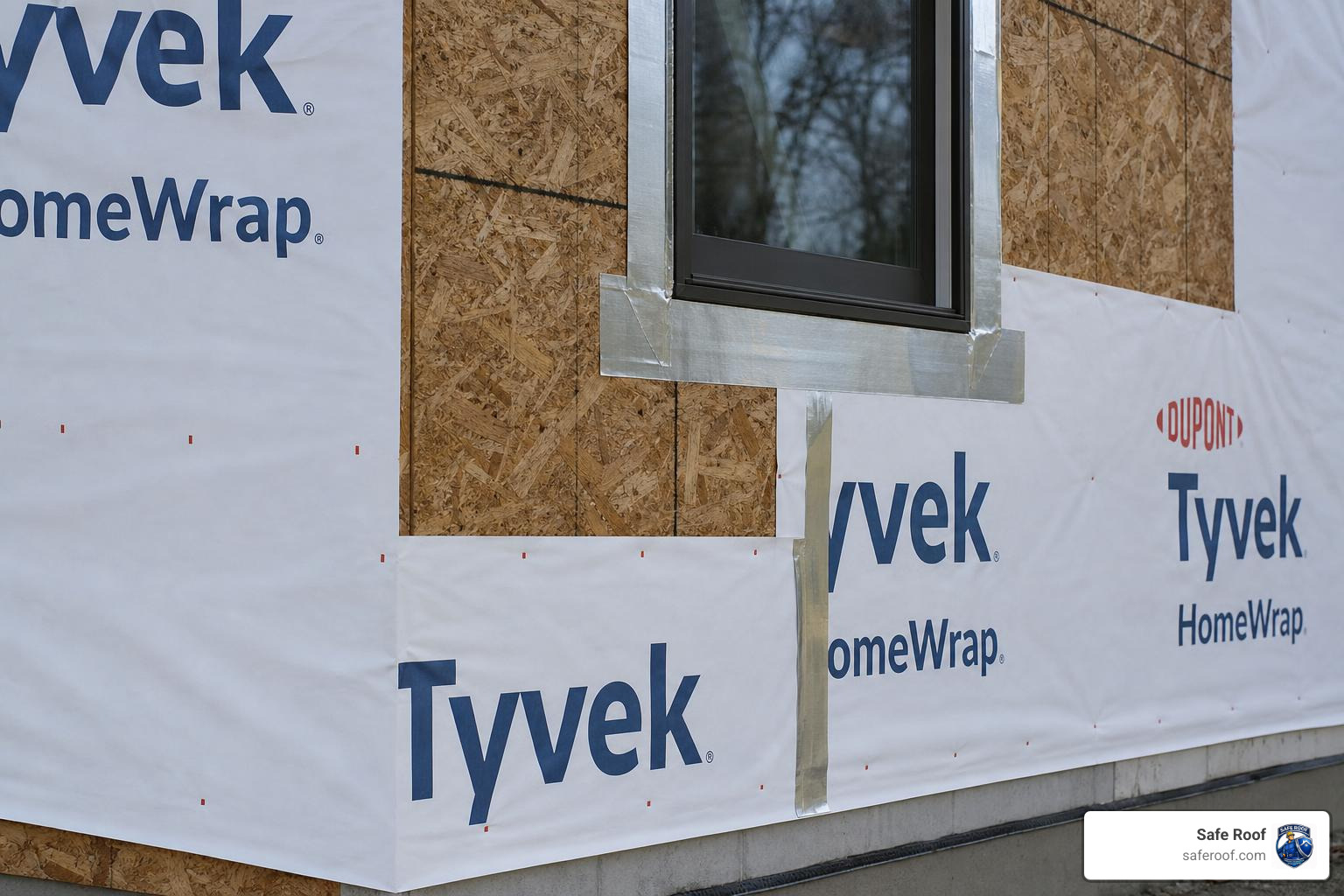
Proper wall preparation involves four critical steps:
- Stripping and Inspecting the Substrate: We remove the old siding down to the bare wood sheathing. We inspect the sheathing for water damage, rot, and insect activity, replacing any compromised panels to ensure a flat, structurally sound nailing surface.
- Installing the Weather-Resistive Barrier (WRB): Siding is not completely watertight. To comply with modern International Residential Code (IRC) requirements, a continuous water-resistive barrier (such as Tyvek housewrap) must be installed over the sheathing. All seams must be taped, and corners must be wrapped continuously to keep water out while allowing interior moisture vapor to escape.
- Flashing and Moisture Management: High-quality flashing is essential around windows, doors, and roof-to-wall intersections. We install kick-out flashing at the lower edge of roof eaves to direct rainwater away from the siding and safely into the gutter system.
- Ensuring Code-Compliant Clearances: Siding must never touch the ground or roofing materials. We maintain a minimum 6-inch clearance between the siding and the finished ground grade, and a 1-inch clearance above roof surfaces to prevent moisture wicking and rot.
Because water damage often affects both your roof and your walls, we coordinate these preparation steps closely with our residential roofing services. Ensuring that your roof’s starter shingles, drip edges, and wall flashing integrate seamlessly with your new siding is the only way to guarantee a 100% leak-proof home envelope.
Step-by-Step Siding Installation Process and Best Practices
Installing siding is a highly systematic process. Before a single panel is nailed to the wall, precise measurements must be taken to ensure accurate material ordering.
To estimate your siding needs, we calculate the total square footage of your exterior walls (multiplying height by width) and add a 10% to 15% waste allowance for cuts, gables, and waste. In the siding industry, materials are measured in “squares,” where one square equals 100 square feet of wall area.

Essential Tools and Materials for Siding Installation
A professional siding installation requires a mix of standard construction equipment and highly specialized siding tools. Using the wrong tools can damage the material or lead to a loose, wavy finish.
- Basic Carpentry Tools: Circular saw (fitted with a fine-tooth plywood blade run in reverse for clean vinyl cuts), utility knife, chalk line, level, tape measure, and hammer.
- Specialty Siding Tools:
- Nail Slot Punch: Used to extend nail slots or punch new ones in field-cut panels.
- Snap Lock Punch: Creates raised tabs on the cut edge of a panel so it locks securely into utility trim.
- Zip Tool (Siding Removal Tool): Allows installers to easily hook and unhook vinyl panels to make adjustments or repairs.
- Fasteners: Only use high-quality, corrosion-resistant fasteners (such as hot-dip galvanized steel or aluminum roofing nails) with a minimum head diameter of 5/16-inch. Nails must penetrate studs at least 3/4-inch to 1-1/2 inches depending on the material.
For an exhaustive breakdown of certified tools and safety gear, consult the official VSI Vinyl Siding Installation Manual.
Critical Rules for Vinyl and Fiber Cement Siding Installation
Siding materials expand and contract constantly as outdoor temperatures change. Vinyl siding, for example, can expand and contract up to 1/2-inch or more over a standard 12-foot-6-inch panel length. If you do not account for this thermal movement, your siding will buckle, warp, and crack.
To prevent this, professional installers adhere to these strict rules:
- Never Nail Siding Tight: Leave a 1/32-inch gap (roughly the thickness of a dime) between the nail head and the siding hem. The panel must be able to slide freely from side to side.
- Center Your Nails: Always drive fasteners directly into the center of the pre-punched nail slots. Nailing at the far ends of a slot locks the panel in place and prevents natural expansion.
- Do Not Face-Nail: Never drive a nail directly through the visible face of a siding panel. This restricts movement and ruins the clean, seamless look of your exterior.
- Leave Expansion Gaps: Leave a minimum 1/4-inch clearance at all receiving channels (such as J-channels and corner posts). If you are installing in freezing weather (below 40°F), increase this expansion gap to 3/8-inch.
Installing Accessories: Starter Strips, J-Channels, and Corner Posts
Before the main siding panels can be hung, you must install the receiving trim and accessories that hold the system together:
- Starter Strips: This is the absolute foundation of your siding system. It is nailed along the very bottom of the wall, perfectly level. The first course of siding locks directly into this strip.
- Corner Posts: Inside and outside corner posts are installed to cover the raw ends of the siding panels. They must be hung from the very top of the uppermost nail slot to ensure they hang straight and plumb.
- J-Channels: These versatile, J-shaped trim pieces are installed around windows, doors, and along the tops of walls to receive and hide the cut edges of the siding panels, ensuring a clean, watertight finish.
Horizontal vs. Vertical Siding Installation Techniques
While horizontal lap siding is the most traditional option, vertical siding (such as Board and Batten) has surged in popularity. The installation techniques for these two styles differ significantly:
- Horizontal Siding: Panels are installed from the bottom up, overlapping successive courses by at least 1 inch. Fasteners are spaced a maximum of 16 inches apart, aligned directly with the wall studs.
- Vertical Siding: Requires the installation of horizontal furring strips (spaced 12 to 16 inches apart) or solid sheathing to provide a secure nailing surface. Panels are hung from the top down to ensure they remain perfectly plumb, with fasteners spaced every 12 inches.
Working Around Windows, Doors, Eaves, and Gables
Navigating wall openings and rooflines requires meticulous attention to detail. Around windows and doors, we install custom metal sill flashing and J-channels to divert water outward.
At gable ends, panels must be cut at precise angles to match the pitch of the roof. We install receiving J-channels along the gable rake to secure the angled cuts. Under the eaves, we install utility trim and use a snap lock punch on the top edge of the siding panels to lock them securely into place without face-nailing.
Frequently Asked Questions About Siding Installation
What is the most common mistake in vinyl siding installation?
The single most common mistake is over-nailing (driving the nails flush against the siding hem). When vinyl siding is nailed too tightly to the wall, it cannot expand and contract with temperature swings. This causes the panels to buckle, warp, and pull away from the wall, creating unsightly waves and allowing water to leak into your home sheathing.
How does new siding impact home energy efficiency?
New siding significantly improves your home’s energy efficiency by eliminating drafts and reducing thermal bridging. When paired with insulated siding (which features a built-in contoured foam backing) or installed over rigid foam sheathing, it adds an extra layer of thermal resistance (typically R-2.0 to R-5.0). This keeps your home warmer in the winter and cooler during hot Texas summers, lowering your monthly energy bills.
How do I know when it is time to replace my siding?
You should consider replacing your siding if you notice any of the following warning signs:
- Visible Damage: Cracking, warping, or holes caused by severe hail or wind.
- Rot or Mold: Soft spots on wood siding or persistent mold growth on the exterior.
- High Energy Bills: A sudden, unexplained rise in your heating and cooling costs.
- Interior Water Stains: Peeling paint or water spots on your interior drywall.
If your home has recently been hit by a major storm, we highly recommend scheduling a professional roof replacement and siding evaluation to check for hidden structural damage before water penetrates your living spaces.
Conclusion
Investing in professional siding installation is one of the smartest ways to protect your home, lower your energy bills, and completely transform your curb appeal. Whether you prefer the low-maintenance convenience of modern vinyl, the fire-resistant durability of fiber cement, or the impact-resistant strength of engineered wood, proper installation is the key to long-term performance.
At Safe Roof, we specialize in helping homeowners across North Texas and Southern Oklahoma — including Dallas TX, Fort Worth TX, Plano TX, McKinney TX, Prosper TX, Celina TX, Sherman TX, Ardmore OK, and Oklahoma City OK — restore their homes after severe storm damage. As a trusted exterior contractor, we pride ourselves on offering enhanced 50-year warranties, full-service insurance claim assistance, and unmatched craftsmanship.
Don’t leave your home’s first line of defense to chance. Contact us today for a free siding installation estimate and let our expert team give your home the beautiful, storm-resistant protection it deserves.