

Professional Siding Installation Services

Your home’s siding is more than a decorative shell, it is the first layer of defense against Oklahoma’s punishing heat, hail, wind-driven rain, and ice storms. When that protective barrier begins to crack, warp, or pull away from the wall sheathing, every month you wait invites moisture intrusion, structural decay, and rising energy bills. 

Safe Roof provides full-service siding installation for homeowners and business owners across Ardmore, Carter County, and the broader Southern Oklahoma and North Texas regions. As a licensed Oklahoma contractor (License #80004931), we combine manufacturer-trained crews with proven materials to deliver siding systems built for this climate.

Whether you need to replace aging vinyl panels, upgrade to fiber cement, or install metal siding on a new build, our team handles every phase of the project, from initial roof inspection and substrate evaluation to final trim work and cleanup. Call (580) 319-6932 or request a free siding estimate to get started.

What Is Siding Installation?

Siding installation is the process of attaching exterior cladding material to a home’s wall sheathing and framing to create a weather-resistant, insulating, and visually appealing building envelope. A properly installed siding system works in concert with house wrap, flashing, and drainage planes to channel water away from the wall cavity and prevent moisture damage to the underlying structure.

In Oklahoma, the Uniform Building Code Commission (OUBCC) has adopted the 2018 International Residential Code with state-specific amendments, meaning every siding project in Ardmore must meet minimum standards for weather-resistive barriers, fastener spacing, and fire resistance. At Safe Roof, compliance with these codes is built into every estimate and installation plan, not treated as an afterthought.

Professional siding installation differs from a simple cosmetic refresh. It typically involves removing existing cladding, inspecting and repairing wall sheathing and framing, installing or replacing house wrap and flashing, then applying the new siding material according to the manufacturer’s specifications. When done correctly, new siding can last 30 to 50 or more years, improve energy efficiency by reducing thermal bridging, and recoup 75 to 85 percent of its cost at resale.

Types of Siding We Install in Texas & Oklahoma

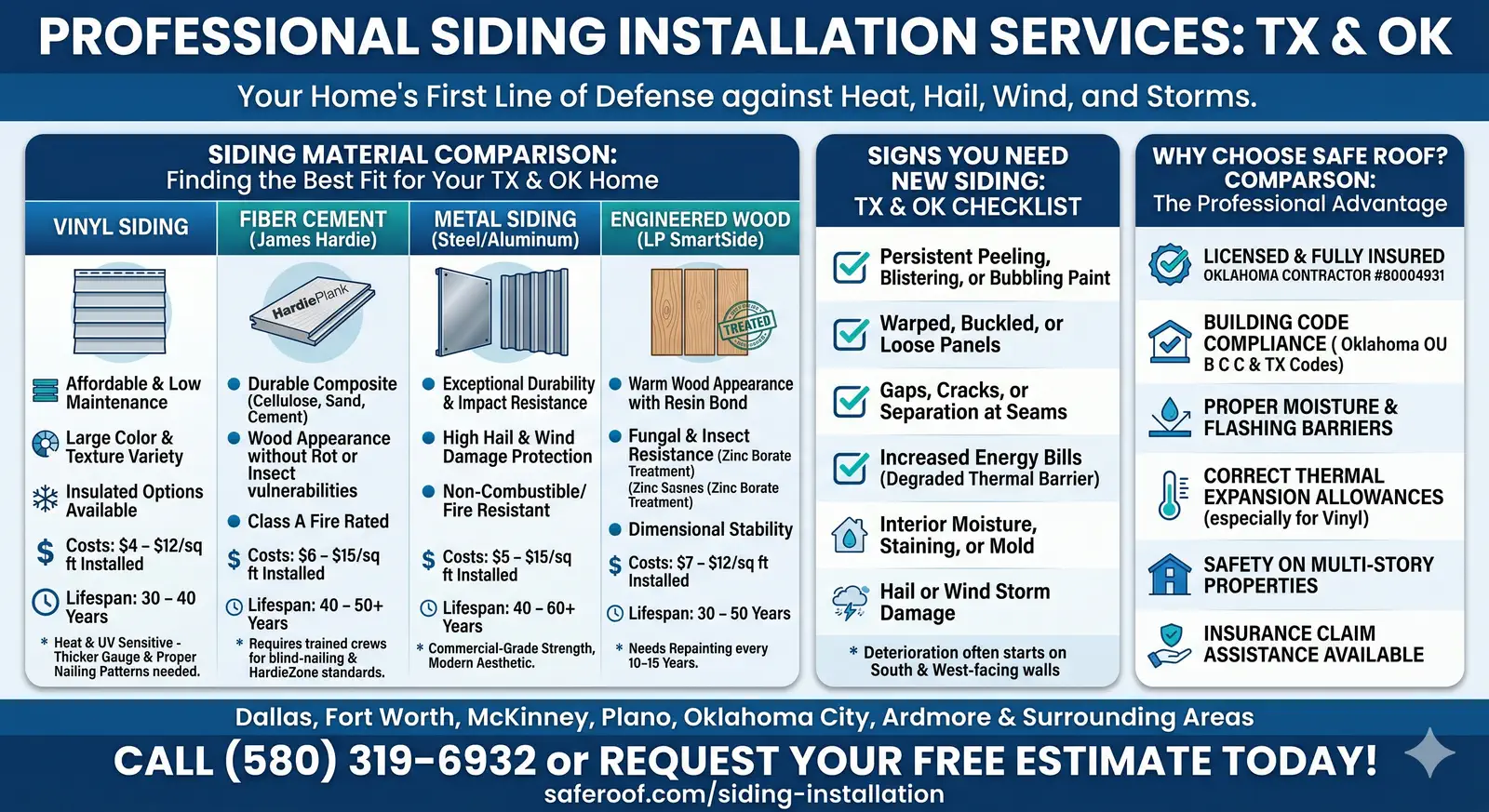
Choosing the right siding material depends on your budget, aesthetic goals, maintenance tolerance, and the specific weather threats your home faces. Below is an overview of the four primary siding types we install in the Ardmore area. If you are also considering a full exterior overhaul, explore our roofing services and gutter installation options for a coordinated project.

Vinyl Siding

Vinyl remains the most popular siding material in the United States, and for good reason. It is affordable, requires virtually no painting or staining, and comes in an enormous range of colors, profiles, and textures, including options that convincingly mimic cedar shake, board-and-batten, and traditional clapboard. Modern insulated vinyl panels add a layer of rigid foam backing that reduces thermal bridging and can improve a wall’s effective R-value.

For Ardmore homeowners, vinyl siding typically costs between $4 and $12 per square foot installed, making it the most budget-friendly option for full-house re-siding projects. A standard 2,000-square-foot home often falls in the $10,000 to $24,000 range once labor, trim, and accessories are included. Vinyl’s weakness is extreme temperature sensitivity, it can become brittle in deep cold and may warp under prolonged direct sunlight in Oklahoma’s July and August heat. Safe Roof addresses this by specifying thicker-gauge, UV-stabilized panels and ensuring proper nailing patterns that allow for thermal expansion and contraction.

Fiber Cement Siding

Fiber cement siding, best known through brands like James Hardie, is a composite material made from Portland cement, cellulose fibers, sand, and water. It delivers the dimensional look of real wood siding without the rot, insect, and fire vulnerabilities that plague natural wood in Oklahoma’s humid, storm-prone climate. Fiber cement is Class A fire rated, carries a typical manufacturer warranty of 30 years, and holds paint significantly longer than wood.

Installation costs run higher than vinyl, generally $6 to $15 per square foot installed, reflecting the material’s weight and the specialized cutting and fastening techniques it requires. Fiber cement must be blind-nailed per the manufacturer’s specifications, and improper installation can void the warranty entirely. Our crews follow James Hardie’s HardieZone guidelines for the Southern Oklahoma climate zone, ensuring correct gap spacing, caulking, and flashing details around windows and doors.

Metal Siding

Metal siding, available in steel and aluminum, offers exceptional durability, fire resistance, and a modern aesthetic that suits both residential and commercial roofing applications. Steel siding withstands impacts that would crack vinyl or chip fiber cement, and it carries no risk of rot or insect damage. Aluminum is lighter and naturally resistant to corrosion, making it a strong choice for homes near bodies of water or in areas with high soil salinity.

Metal siding installation costs typically range from $5 to $15 per square foot, depending on the gauge, finish, and panel style. While the upfront investment is higher than vinyl, metal siding’s lifespan can exceed 50 years with minimal maintenance beyond occasional washing. For homeowners in Ardmore who have experienced hail damage or wind damage to existing siding, metal panels provide significantly higher impact resistance.

Engineered Wood Siding

Engineered wood siding, such as LP SmartSide, is manufactured from wood strands bonded with resin and treated with zinc borate for insect and fungal resistance. It offers the warm, authentic look of natural wood at a lower price point and with greater dimensional stability. Engineered wood comes in lap, panel, and trim profiles and can be factory-primed or pre-finished in a wide range of colors.

Costs typically fall between $7 and $12 per square foot installed. Engineered wood performs well in Oklahoma’s climate when properly installed with adequate clearance from grade, correct flashing at transitions, and a quality topcoat. It does require repainting every 10 to 15 years, but avoids the splitting, checking, and warping issues common with traditional cedar or pine clapboard.

Licensed Commercial & Residential Roofing Contractor

Trusted and licensed contractor for commercial and residential roofing—quality materials, expert service, and lasting protection guaranteed.

LICENSE NUMBER: 80004931

Siding Installation Cost Comparison in Texas & Oklahoma

Understanding the true cost of siding installation means looking beyond the per-square-foot material price. The table below compares the four primary siding types Safe Roof installs across key cost and performance metrics, helping Ardmore homeowners make an informed decision based on total value rather than sticker price alone.

Siding Material

Installed Cost (per sq ft)

Typical Lifespan

Maintenance Level

Fire Resistance

Warranty Range

Vinyl

$4 – $12

30 – 40 years

Low (wash only)

Melts, not fire rated

20 – lifetime

Fiber Cement

$6 – $15

40 – 50+ years

Low–moderate (repaint every 15–20 yrs)

Class A

30 years

Metal (Steel/Aluminum)

$5 – $15

40 – 60+ years

Very low (wash only)

Non-combustible

30 – 40 years

Engineered Wood

$7 – $12

30 – 50 years

Moderate (repaint every 10–15 yrs)

Varies by treatment

5 – 50 years

Note: Costs are national averages as of 2026 and may vary based on home size, project complexity, and local labor rates. Contact Safe Roof for a site-specific estimate in the Ardmore area.

Our Siding Installation Process

A siding replacement is a multi-day project that requires careful sequencing to protect your home’s wall cavity from moisture during the transition. Here is how Safe Roof approaches every siding installation, from first contact to final walkthrough.

Step 1: On-Site Evaluation and Measurements

Every project begins with a thorough exterior inspection. We assess the condition of your existing siding, wall sheathing, flashing, and trim. We measure the total square footage of the exterior wall area, deducting for windows, doors, and other openings. This step also identifies any underlying issues, rotted sheathing, pest damage, or inadequate house wrap, that need to be addressed before new siding goes on. Schedule your evaluation by calling (580) 319-6932 or visiting our contact page.

Step 2: Material Selection and Estimate

Based on the inspection findings, your home’s architectural style, and your budget, we recommend specific siding materials, profiles, and colors. We present a detailed written estimate that breaks out material costs, labor, old siding removal and disposal, house wrap and flashing, trim and accessories, and permits. There are no hidden fees.

Step 3: Old Siding Removal

We strip the existing siding down to the wall sheathing, taking care to identify and document any concealed damage. Old siding removal typically costs $0.70 to $2.00 per square foot depending on the material, vinyl is fast to remove, while stucco or layered siding takes considerably more labor. All debris is hauled off-site the same day.

Step 4: Sheathing Repair, House Wrap, and Flashing

With the walls exposed, we repair or replace any damaged sheathing panels, treat for pest activity if present, and install a code-compliant weather-resistive barrier (house wrap). Flashing goes in at every window head, sill, and jamb; at roof-to-wall transitions; and around penetrations like hose bibs and light fixtures. This step is invisible once the siding goes on, but it is the most critical layer for long-term moisture protection.

Step 5: Siding Panel Installation

New siding is installed from the bottom up, starting with the starter strip at the base of the wall and working toward the eaves. Each material has specific nailing, overlap, and clearance requirements set by the manufacturer. Vinyl, for example, must be nailed loosely to allow for thermal expansion, a detail that many DIY installations get wrong, leading to buckling and cracking in Oklahoma’s temperature extremes. Our installers are trained to follow manufacturer specifications exactly, which is essential to maintaining your warranty.

Step 6: Trim, Caulking, and Final Details

J-channels, corner posts, window and door casings, soffit, and fascia trim are all installed and caulked with a high-quality, paintable sealant. Every seam and transition point is inspected for proper overlap and drainage. We then conduct a full walkthrough with you to confirm everything meets your expectations.

Step 7: Site Cleanup and Warranty Registration

All scrap material, nails, and packaging are removed from your property. We register your siding warranty with the manufacturer and provide you with documentation that includes the materials used, warranty terms, and maintenance recommendations.
Why Choose Safe Roof

  • Single Contractor for Roof, Siding, and Gutters — Safe Roof handles roofing, siding, and gutter installation as a coordinated exterior project, ensuring correct integration at every transition point where mismatched installations from separate contractors consistently create moisture infiltration problems.
  • Storm Damage Siding Expertise — After hail and wind events across the DFW metro and South Oklahoma, Safe Roof inspects and documents siding damage alongside roofing scope, providing a single, comprehensive damage report for insurance claims that covers every affected exterior component.
  • Manufacturer Specification Compliance — Every Safe Roof siding installation follows the specific fastening, flashing, clearance, and overlap requirements published by the siding manufacturer, the standard required to activate and maintain the full material warranty on every product we install.
  • Correct Flashing at Every Transition — Safe Roof installs dedicated metal flashing at every window, door, penetration, and wall transition, not sealant alone, providing the moisture protection that Texas and Oklahoma’s wind-driven rain requires at every vulnerable connection point.
  • Insurance Claim Documentation — Safe Roof documents storm-damaged siding to the standard carriers and adjusters require, identifying scope items that underpaid estimates miss, and provides a complete insurance documentation package covering both roofing and siding on every storm damage claim.
  • Licensed and Insured in Both States — Oklahoma Roofing Contractor #80004931. Full general liability and workers’ compensation coverage on every siding installation project across Texas and Oklahoma.

Signs You Need New Siding in Texas & Oklahoma

Siding does not fail all at once, deterioration usually starts in the areas most exposed to weather, the south and west-facing walls in Texas and Oklahoma where UV intensity and storm exposure are highest, and progresses gradually. If you notice any of the following signs across your property, it is time to schedule a siding evaluation.

  • Persistent peeling, blistering, or bubbling paint — Often a symptom of moisture trapped behind the siding rather than a cosmetic issue. If repainting solves the problem for only a year or two before the cycle repeats, the siding substrate is likely compromised and paint is masking a larger moisture infiltration problem.
  • Warped, buckled, or loose panels — Indicate either improper installation, material failure, or ongoing moisture exposure behind the wall surface. Warped vinyl siding in Texas and Oklahoma is often the result of thermal stress from extreme summer heat combined with moisture cycling during spring storm season.
  • Faded, chalky, or brittle vinyl siding — Vinyl that has become chalky or brittle has exhausted its UV stabilizers, a particularly accelerated process in Texas and Oklahoma where summer UV intensity is among the highest in the country. At this stage the material is no longer providing reliable weather protection.
  • Visible rot, soft spots, or fungal growth — Particularly around windows, doors, and near the foundation. These indicators mean water has been penetrating the wall cavity for an extended period, a condition that worsens rapidly during Texas and Oklahoma’s spring and summer storm seasons.
  • Gaps, cracks, or separation at seams and joints — Openings in siding seams allow wind-driven rain to enter the wall cavity directly, a significant risk given the sustained wind speeds and rainfall intensity Texas and Oklahoma experience regularly during severe storm events.
  • Increased energy bills without a clear explanation — Failing siding with degraded or missing house wrap behind it allows thermal bridging and air infiltration that raises heating and cooling costs, a measurable impact in Texas and Oklahoma where summer cooling loads are already high. Rising utility bills warrant an exterior evaluation alongside a roof inspection to rule out issues on multiple fronts.
  • Interior moisture, staining, or mold on inside walls — Moisture appearing on interior wall surfaces indicates the exterior envelope has failed, water is reaching the wall cavity and migrating inward through the sheathing.
  • Storm damage from hail or high winds — Hail dents and cracks vinyl siding and wind events tear panels from the wall, damage that is not always immediately visible from the ground but compromises moisture protection on every subsequent rain event. If your area has experienced a significant weather event, Safe Roof’s storm damage roofing team can inspect both your roof and siding in a single visit, and our insurance claims assistance team can help you navigate the filing process.

Why Hire a Professional Instead of DIY for Siding Installation in Oklahoma & Texas ?

Online tutorials make siding installation look straightforward, but improper installation is one of the leading causes of premature siding failure and voided manufacturer warranties in Texas and Oklahoma. Here is why working with a licensed contractor like Safe Roof matters.

  • Manufacturer Warranty Compliance — Major siding producers, James Hardie, LP Building Solutions, and CertainTeed, require installation by trained professionals following specific fastening, flashing, and clearance protocols. A DIY installation that skips the starter strip, uses incorrect nail spacing, or omits flashing at transitions may void a warranty worth thousands of dollars before the first Texas or Oklahoma storm season tests the installation.
  • Building Code Compliance — Oklahoma’s adoption of the International Residential Code means siding projects must meet specific standards for weather-resistive barriers, fastener types, and fire resistance depending on proximity to property lines. Texas municipalities carry similar requirements. A licensed contractor understands these standards, pulls the necessary permits, and ensures the installation passes inspection.
  • Flashing and Moisture Barrier Integration — Correct flashing around windows, doors, penetrations, and transitions is one of the most technically demanding aspects of siding installation, and one of the most frequently skipped on DIY projects. Improper flashing in Texas and Oklahoma’s high-rainfall, high-wind climate creates moisture infiltration pathways that damage sheathing and framing within a few storm seasons.
  • Safety on Two-Story and Multi-Story Properties — Siding a two-story home requires scaffolding or ladder work at heights that present serious fall risks, alongside power tools for cutting fiber cement and composite panels. Professional crews carry liability insurance and workers’ compensation coverage. Safe Roof’s Oklahoma license (#80004931) confirms these protections are in place on every project.
  • Correct Thermal Expansion Allowances — Vinyl siding in Texas and Oklahoma experiences extreme thermal expansion and contraction between summer highs above 100°F and winter lows below freezing. Panels installed without correct expansion gaps buckle and separate within a few seasonal cycles, a common DIY failure that voids material warranties and requires full reinstallation.
  • Faster Project Completion Reduces Weather Exposure Risk — An experienced Safe Roof crew completes a typical residential re-siding project in three to five days, with the wall cavity properly protected throughout. A DIY project attempted over weekends leaves sheathing and framing exposed to Texas and Oklahoma’s unpredictable spring weather for extended periods, increasing the risk of moisture damage to structural components before the siding is even finished.
  • Insurance Claim Eligibility — Storm damage siding replacement covered by insurance requires installation by a licensed contractor to maintain claim eligibility and manufacturer warranty coverage. A DIY replacement on an insurance-covered scope may result in the insurer declining future claims related to the same siding system.

Choosing the Best Siding for Your Texas & Oklahoma Home — Priority-Based Selection Guide

Selecting a siding material involves balancing aesthetics, durability, budget, and climate suitability, and the right answer varies significantly based on what a Texas or Oklahoma property owner values most. According to Remodeling Magazine’s Cost vs. Value Report, siding replacement consistently ranks among the top exterior home improvement projects for return on investment, making product selection one of the most financially consequential exterior decisions a property owner makes. This table maps common homeowner priorities to the siding product that best addresses each.

Homeowner Priority

Best Siding Choice

Why It Fits for TX & OK

Relative Cost

Lowest upfront cost

Vinyl

Material and labor costs are the lowest of any major siding type — appropriate for budget-constrained projects

Lowest

Maximum storm and hail resistance

Fiber cement or metal steel

Fiber cement resists hail impact without cracking — metal steel provides highest impact resistance in the category

Moderate to high

Authentic wood appearance

Engineered wood or fiber cement

Both replicate real wood profiles without the rot, splitting, and maintenance burden of natural wood in TX and OK humidity

Moderate

Class A fire resistance

Fiber cement

Class A rated — required in fire-prone zones and increasingly relevant in North Texas wildland interface areas

Moderate

Lowest lifetime maintenance

Metal aluminum

No painting, no rot, no insect risk — periodic washing only for the life of the installation

Moderate

Highest resale value

Fiber cement (James Hardie)

Strong curb appeal and documented durability command premium resale values in DFW and OKC markets

Moderate to high

Energy efficiency improvement

Insulated vinyl

Foam-backed panels reduce thermal bridging — measurable cooling cost reduction in TX and OK summer heat

Low to moderate

Historic or HOA design compliance

Fiber cement

Available in period-accurate profiles — HardiePlank and HardieShingle satisfy strict design guidelines in established neighborhoods

Moderate to high

Commercial property durability

Metal steel or fiber cement

Both handle heavy use, high wind exposure, and long ownership cycles without significant maintenance requirements

Moderate to high

Mixed-material approach

Fiber cement front — vinyl sides

Maximizes street-facing curb appeal while controlling overall project cost on less visible elevations

Variable

For many Oklahoma & Texas homeowners, the right answer is a combination, for example, fiber cement on the front elevation for maximum curb appeal, with vinyl on the less visible sides to control overall project cost. Safe Roof can help you plan a mixed-material approach that balances appearance and budget.

What Our Customers Say

Proudly Serving Texas & Oklahoma With Expert Siding Installation Services

Safe Roof installs and replaces siding for residential and commercial property owners across our full Texas and Oklahoma service area, providing manufacturer-specification siding installations with correct house wrap, flashing integration, and trim work that protect homes and businesses across the DFW Metroplex and South-Central Oklahoma from the hail impact, wind-driven rain, and UV intensity that make exterior envelope quality one of the most consequential decisions a Texas or Oklahoma property owner makes.

Our service areas include: Dallas, Far North Dallas, Fort Worth, Prosper, Celina, Plano, Sherman, McKinney, Oklahoma City, Ardmore and  surrounding areas. If you are looking for a broader view of our coverage, then see our full service area page here. 

Schedule Your Free Siding Installation Estimate in Texas & Oklahoma Today

New siding does more than improve curb appeal, it restores your home’s first line of defense against the hail impacts, wind-driven rain, and UV intensity that Texas and Oklahoma exteriors absorb year after year. Whether your current siding is storm-damaged, aging past its service life, or simply no longer performing at the level your property deserves, Safe Roof is ready to assess your exterior and walk you through your material options with no pressure and no obligation.

Our licensed and insured crew serves residential and commercial property owners across Dallas, Fort Worth, McKinney, Plano, Oklahoma City, Ardmore, and surrounding communities, coordinating siding installation with roofing and gutter scope when needed for a complete, integrated exterior restoration on a single project timeline.

Call (580) 319-6932, visit our free roof quote page, or reach out through our contact page to schedule your free siding installation estimate today.

Frequently Asked Questions

How long does a siding installation take in Texas or Oklahoma?

Most standard single-story residential replacements take three to five working days. Two-story homes or projects requiring sheathing repair may take a full week or longer. Safe Roof provides a specific project timeline in your written estimate before any work is scheduled.

Do I need a permit to replace siding in Texas or Oklahoma?

In most cases, yes. Oklahoma municipalities and most Texas cities require a building permit for siding replacement to meet code requirements for weather-resistive barriers and flashing. Requirements vary by city and county, Safe Roof handles the permitting process as part of every project.

Can new siding be installed over old siding in Texas or Oklahoma?

Safe Roof recommends full removal in most cases. Layering siding conceals rot, moisture damage, and pest activity that continues to worsen, particularly in Texas and Oklahoma where wind-driven rain accelerates moisture damage behind compromised siding. Full removal also allows inspection and upgrade of the house wrap and flashing beneath.

Will new siding lower my energy bills in Texas or Oklahoma?

It can. Insulated vinyl siding reduces thermal bridging during summer months when wall temperatures in both states regularly exceed 130°F. The U.S. Department of Energy recommends evaluating wall insulation as part of any siding replacement project for maximum energy savings in high-heat climates like Texas and Oklahoma.

Does Safe Roof offer financing for siding installation in Texas or Oklahoma?

Contact us at (580) 319-6932 or through our contact page to discuss current financing options and payment plans available across our Texas and Oklahoma service area.

How does Safe Roof handle storm-damaged siding in Texas or Oklahoma?

Safe Roof provides storm damage assessments covering both roof and siding in a single inspection visit, and works directly with your insurance company through our insurance claims assistance program to ensure siding damage is fully documented and included in the claim scope.

What siding materials does Safe Roof install in Texas and Oklahoma?

Safe Roof installs vinyl siding, fiber cement siding including James Hardie products, engineered wood siding including LP SmartSide, and composite siding across our service area. Product selection is matched to your storm exposure, budget, and ownership timeline, from a standard vinyl installation on a rental property to a full James Hardie installation on a primary residence in the DFW metro or Oklahoma City market.

Does new siding increase home value in Texas or Oklahoma?

Yes. Remodeling Magazine’s Cost vs. Value Report consistently ranks siding replacement among the top exterior projects for resale return. In Texas and Oklahoma’s hail-aware real estate markets, storm-damaged or aging siding is an active negotiating point at closing, new siding eliminates that leverage entirely.

Safe Roof

Business Hours
Monday: Open 24 hours
Tuesday: Open 24 hours
Wednesday: Open 24 hours
Thursday: Open 24 hours
Friday: Open 24 hours
Saturday: Open 24 hours
Sunday: Open 24 hours

Your Elite Residential and Commercial Roofing Team in Texas & Oklahoma

Whether you’re dealing with storm damage, planning a replacement, or just want a professional opinion on your roof’s condition, Safe Roof is ready to help. We serve property owners across Texas and Oklahoma, showing up on time, doing the work right, and standing behind every install with GAF-certified warranty coverage.

Getting an estimate costs nothing and commits you to nothing. We’ll assess your roof, walk you through the findings, and provide a clear written estimate.