
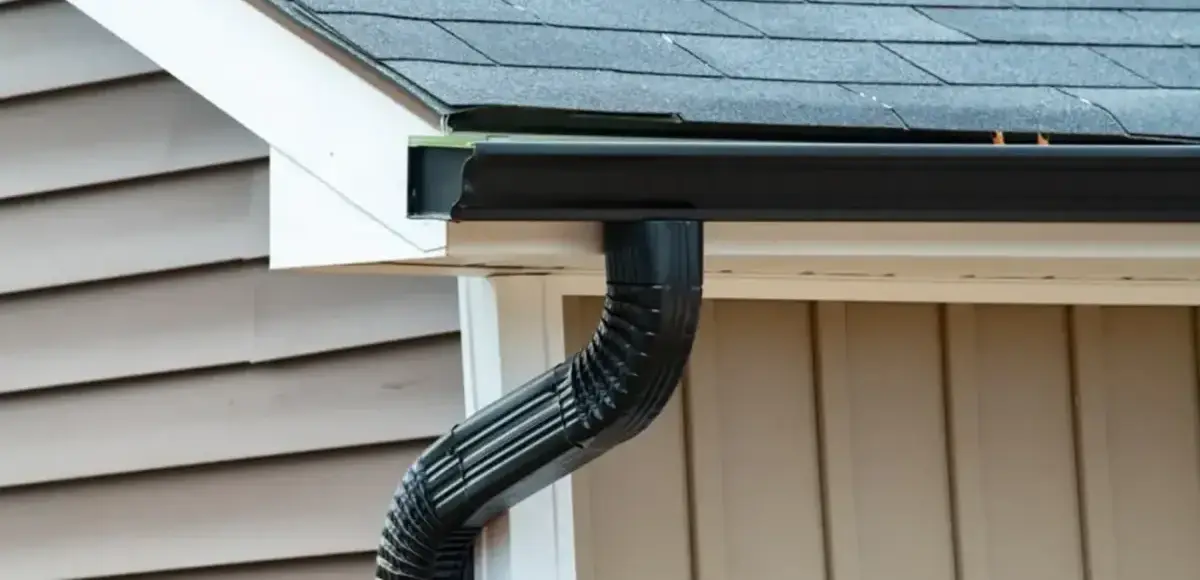





Professional Gutter Installation Services
A properly installed gutter system is one of the most cost-effective investments you can make to protect your home. Gutters channel rainwater away from your foundation, siding, and landscaping, preventing the kind of slow, hidden damage that leads to thousands of dollars in repairs. According to the National Association of Home Builders, water intrusion is among the most common and expensive sources of structural damage in residential construction, and functioning gutters are the first line of defense.
At Safe Roof, we provide complete gutter installation services for homeowners and businesses across Ardmore, Carter County, and the surrounding southern Oklahoma communities. Whether you need a full gutter system on a new build, a seamless aluminum upgrade on an older home, or gutter guards to reduce long-term maintenance, our licensed team (Oklahoma License #80004931) handles every step from measurement through final inspection.
We pair our gutter work with the same attention to detail that defines our roofing services. Because your roof and your gutters function as a single water-management system, having one contractor handle both ensures proper integration at the drip edge, fascia, and downspout connections, areas where mismatched installations frequently fail.
Why Gutters Matter More Than You Think in Texas & Oklahoma
It is easy to overlook gutters because they sit at the edge of your roofline, out of sight and out of mind, until something goes wrong. Homes without gutters or with failing gutter systems face a range of problems that compound over time.
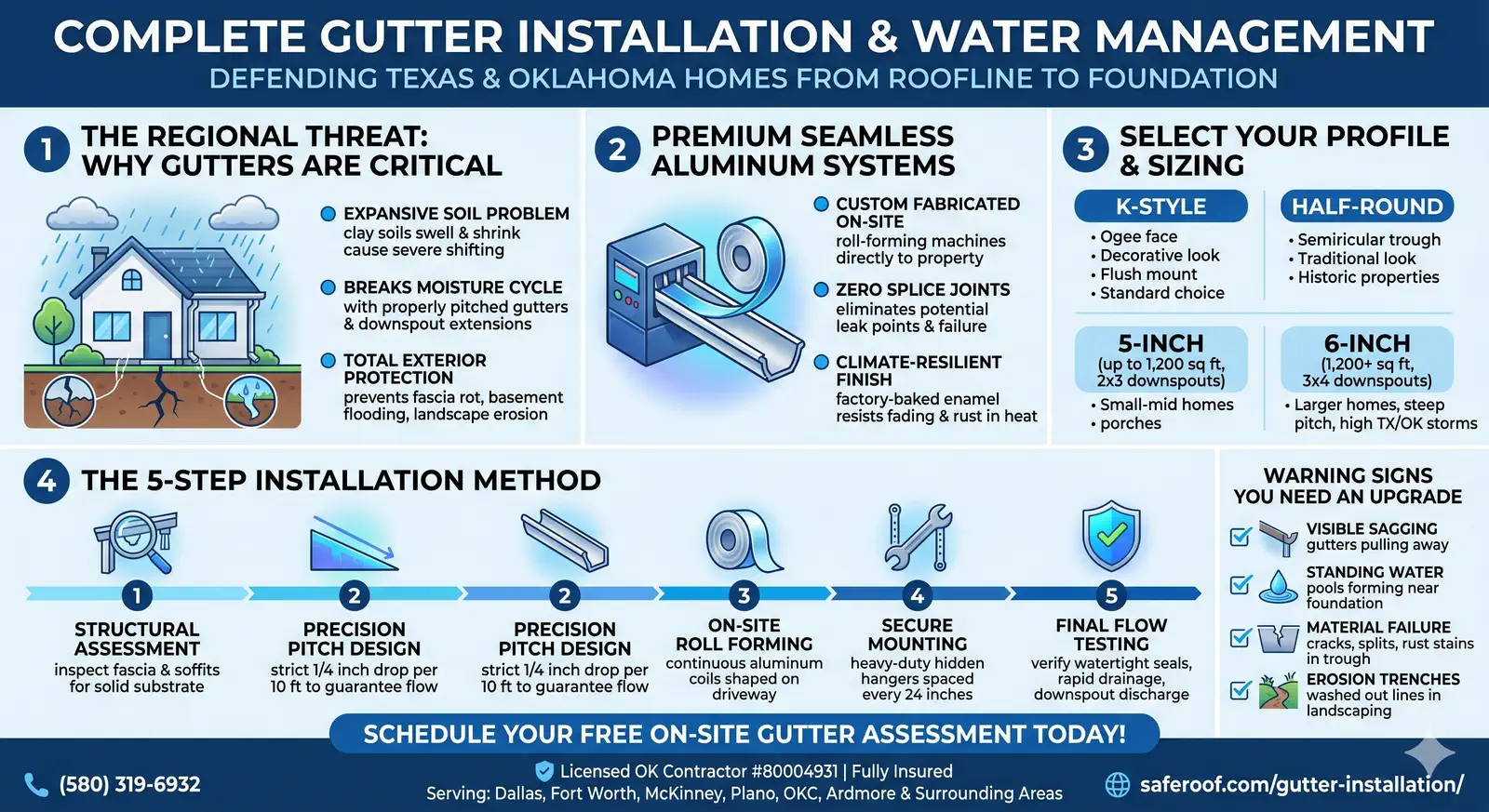
Uncontrolled roof runoff saturates the soil around your foundation, and in Oklahoma’s expansive clay soils, that moisture cycle of saturation and drying causes the ground to swell and shrink unevenly. Over time, this leads to foundation shifting, cracked slabs, and sticking doors and windows. The Oklahoma Geological Survey has documented that expansive soils are responsible for more property damage in the state than any other natural hazard, including tornadoes. A gutter system that routes water at least four to six feet from the foundation through properly extended downspouts is the simplest way to break that cycle.
Beyond the foundation, missing or failed gutters cause fascia board rot, soffit deterioration, basement flooding, landscape erosion, and staining on exterior siding. Homes with intact gutter systems in good condition also appraise higher and sell faster, because buyers and inspectors specifically look for water management when evaluating a property.
If you have noticed water pooling near your foundation, paint peeling under your eaves, or erosion channels forming in your flower beds, those are signs your current gutters are failing or absent. Our team can evaluate the situation during a free roof quote visit and recommend the right system for your home.
Types of Gutter Systems We Install Texas & Oklahoma
Not every home needs the same gutter setup. The right system depends on your roof size, pitch, local rainfall intensity, and budget. Here is an overview of the primary gutter types we install in the Ardmore area.
Seamless Aluminum Gutters
Seamless aluminum gutters are the most popular choice for residential installations nationwide, and for good reason. They are fabricated on-site from a single continuous coil of aluminum using a portable roll-forming machine, which means the only joints in the system are at inside corners, outside corners, and downspout outlets. Fewer joints means fewer potential leak points, which translates directly to longer service life and lower maintenance.
Seamless aluminum gutters are available in 5-inch and 6-inch profiles (measured across the top opening), with 6-inch being the preferred size for homes in Oklahoma where heavy spring and summer storms can dump two or more inches of rain per hour. The material is naturally rust-resistant, lightweight, and available in dozens of factory-baked enamel colors that will not peel or fade for decades.
K-Style vs. Half-Round Profiles
K-style gutters have a flat back, a decorative ogee face, and a flat bottom, which gives them a strong visual resemblance to crown molding. They are the standard profile on the vast majority of residential homes built in the last 50 years because they hold more water per linear foot than half-round gutters of the same width and mount flush against the fascia board.
Half-round gutters have a semicircular trough and are most often seen on historic homes, craftsman-style architecture, and properties where a more traditional aesthetic is desired. Both profiles perform well when correctly sized and installed; the choice typically comes down to architectural style and personal preference.
Gutter Guards and Leaf Protection
Gutter guards are screens, covers, or inserts that sit over or inside the gutter trough to keep leaves, pine needles, and debris out while still allowing water to flow through. For homes surrounded by mature trees, a common situation in Carter County’s older neighborhoods, gutter guards can dramatically reduce the frequency of gutter cleaning, from two to four times per year down to once every few years.
We install several styles of gutter protection including micro-mesh screens, reverse-curve covers, and brush-style inserts, and we will recommend the best option based on the type of tree canopy around your home. Gutter guards are also available as an add-on to any new gutter installation or as a standalone upgrade to your existing system.
Downspouts and Drainage Extensions
Downspouts are the vertical pipes that carry water from the gutter trough to ground level, and they are just as important as the gutters themselves. We typically install 2×3-inch rectangular downspouts for 5-inch gutter systems and 3×4-inch downspouts for 6-inch systems, sized to handle the maximum flow rate of the gutter without backing up.
Every downspout includes an extension or splash block at the base to direct water at least four feet away from the foundation. For homes with persistent drainage issues, we can also connect downspouts to underground drain lines that route water to a pop-up emitter or dry well further out in the yard.
Areas We Serve
Licensed Commercial & Residential Roofing Contractor
Trusted and licensed contractor for commercial and residential roofing—quality materials, expert service, and lasting protection guaranteed.
LICENSE NUMBER: 80004931
Gutter Material Comparison — What Texas & Oklahoma Homeowners Need to Know
Choosing the right gutter material is one of the most important decisions in a gutter installation project, and the right answer for a Texas or Oklahoma property differs from what works in milder climates. This table compares the four most common residential gutter materials across key performance and cost factors so property owners can make an informed selection before requesting an estimate.
Material | Cost Per Linear Foot (Installed) | Typical Lifespan | Maintenance Level | Performance in TX & OK Climate | Best Application |
Aluminum (Seamless) | $6 to $12 | 20 to 30 years | Low — occasional cleaning, no rust treatment needed | Excellent — naturally rust-resistant, handles TX and OK thermal cycling and storm exposure reliably | Most residential homes — best all-around value and performance across both states |
Vinyl | $3 to $6 | 10 to 15 years | Low initially — joints loosen and material becomes brittle under UV and temperature extremes | Poor — degrades rapidly under TX and OK summer heat and wide temperature swings | Not recommended for primary TX and OK residential applications |
Steel (Galvanized) | $8 to $15 | 15 to 25 years | Moderate — requires periodic rust inspection and spot treatment | Good — handles heavy debris impact better than aluminum | Heavy-duty commercial or industrial applications with high debris exposure |
Copper | $25 to $40+ | 50+ years | Very low — develops natural patina, virtually no corrosion | Excellent — premium longevity in any climate | Historic homes, high-end custom builds, and architectural accent applications |
Aluminum is the material we recommend and install most frequently in the Ardmore service area because it strikes the best balance between durability, appearance, and cost. Vinyl gutters, while inexpensive upfront, degrade quickly under Oklahoma’s intense summer heat and wide temperature swings, leading to warping, cracking, and premature failure. Copper is an exceptional material but carries a significant price premium that makes it impractical for most residential projects.
Our Gutter Installation Process
Every gutter installation we perform follows a structured process designed to ensure accurate fit, proper drainage, and long-term reliability. Here is what you can expect when you work with Safe Roof.
Step 1: On-Site Measurement and Assessment
We begin with a detailed inspection of your roofline, fascia boards, and existing drainage conditions. Our technicians measure every run of gutter needed, identify the optimal downspout placement based on roof slope and drainage patterns, and check the condition of the fascia and soffit to make sure the mounting surface is sound. If we find structural issues like rotted fascia or damaged soffit, we will address those before installing new gutters so the system has a solid foundation to attach to.
Step 2: System Design and Slope Calculation
Gutters must be sloped toward each downspout at approximately one-quarter inch per ten feet of run to ensure water flows efficiently without pooling. The International Residential Code provides minimum slope guidelines that Safe Roof meets or exceeds on every project, preventing standing water in the trough that accelerates corrosion in Texas and Oklahoma’s high-heat, high-humidity summers.
Step 3: On-Site Fabrication
For seamless aluminum systems, we bring our roll-forming equipment to your property and fabricate each gutter section on-site to the exact measurements taken during the assessment. This eliminates the splice joints found in pre-cut sectional gutters and produces a cleaner, more watertight result.
Step 4: Installation and Sealing
We mount the gutters using hidden hangers spaced no more than 24 inches apart, which provides strong support without visible fasteners on the face of the gutter. All end caps, miters, and outlet drops are sealed with professional-grade gutter sealant to prevent leaks. Downspouts are secured with brackets at the top and bottom and at every joint, and extensions are positioned to direct water well away from the foundation.
Step 5: Testing and Final Walkthrough
Before we leave, we run water through the entire system to verify proper flow, check for leaks at every connection, and confirm that downspouts are discharging correctly. We walk through the completed installation with you, answer any questions, and provide care and maintenance guidance to help your new gutters last as long as possible.
Why Choose Safe Roof
- Fascia Inspection Before Every Installation — Safe Roof inspects every fascia board before new gutters go up, identifying and repairing rotted or damaged sections that would compromise gutter attachment and accelerate failure within the first storm season.
- Seamless Gutters Fabricated On-Site — We fabricate seamless gutters on-site to the exact length required for your property, eliminating the seam points where sectional gutters most commonly crack, separate, and leak.
- Correct Pitch and Hanger Spacing — Every Safe Roof gutter installation is pitched to the correct drainage slope and fastened with hidden hangers at proper spacing, the two installation details that determine whether gutters drain correctly and hold through Texas and Oklahoma wind events.
- Storm Damage Gutter Replacement — After hail and wind events across the DFW metro and South Oklahoma, Safe Roof replaces storm-damaged gutters as part of a complete exterior restoration, coordinating gutter scope with roofing and siding work for a single-contractor project.
- Downspout Placement for Foundation Protection — Safe Roof positions downspouts and extensions to direct water away from your foundation, the primary function of a correctly installed gutter system and the one most frequently compromised by improper installation.
- Gutter Guard Options — Safe Roof installs gutter guard systems that reduce debris accumulation and maintenance requirements, particularly relevant in Texas and Oklahoma where spring storm debris and leaf fall create chronic clogging issues on unprotected gutters.
- Licensed and Insured in Both States — Oklahoma Roofing Contractor #80004931. Full general liability and workers’ compensation coverage on every gutter installation project across Texas and Oklahoma.
Gutter Size Selection Guide — Texas & Oklahoma Rainfall and Roof Area Reference
Selecting the correct gutter size is critical to preventing overflow during the intense rainfall events that Texas and Oklahoma produce during spring and summer storm season. This table outlines how roof drainage area factors into the correct gutter and downspout sizing for our regional rainfall conditions, helping property owners understand why Safe Roof recommends specific profiles during the free estimate visit.
Roof Drainage Area | Recommended Gutter Size | Recommended Downspout Size | Typical Application in TX & OK |
Up to 1,200 sq ft | 5-inch K-style | 2×3-inch rectangular | Small to mid-size single-story homes, detached garages, and covered porches |
1,200 to 2,100 sq ft | 6-inch K-style | 3×4-inch rectangular | Larger single-story homes, two-story homes, and most standard residential applications across TX and OK |
2,100 sq ft and above | 6-inch K-style or 7-inch commercial | 3×4-inch or 4-inch round | Large two-story homes, multi-family buildings, and commercial properties with extensive roof drainage |
Steep pitch factor | Increase one size from standard | Increase accordingly | Steep pitch accelerates runoff — effective drainage area increases and requires larger or additional downspouts |
Multiple valley convergence | Increase downspout count | Add downspout at each valley | Valley convergence concentrates flow — additional downspout placement prevents overflow at high-volume points |
Commercial flat roof | 6-inch or larger box gutter | 4-inch round minimum | Low slope commercial systems accumulate water volume rapidly — undersized gutters create overflow and membrane stress |
These are general guidelines. Factors like steep roof pitch, multiple convergence points, and the presence of roof valleys can increase effective drainage area and require larger or additional downspouts. During your assessment, we calculate the exact drainage load for each section of your roof to ensure the system we install can handle Oklahoma’s most intense storms without overflowing.
Signs You Need New Gutters in Texas & Oklahoma
Gutters do not last forever, and waiting until a visible failure occurs often means the underlying damage to your fascia, foundation, or landscaping has already started. If you notice any of the following signs across your Texas or Oklahoma property, it is time to schedule an evaluation.
- Sagging or pulling away from the fascia — One of the most common gutter failure signs across Texas and Oklahoma. Usually indicates corroded hangers, deteriorating fascia board, or accumulated debris weight that the existing system can no longer support.
- Visible cracks, splits, or holes in the trough — Especially common along seams on sectional systems. Cracks allow water to leak directly onto the fascia and siding rather than flowing to the downspout, accelerating rot and moisture damage with every rain event.
- Peeling paint or rust stains on or below the gutters — Indicates water sitting in the trough rather than draining properly. In Texas and Oklahoma’s high-heat, high-humidity summers, standing water in gutters accelerates corrosion and shortens system life significantly.
- Water pooling around the foundation after rainstorms — A strong indicator that gutters are clogged, improperly sloped, or undersized for the roof area they serve. Foundation moisture damage from failed gutters is one of the most expensive home repair consequences in both states.
- Mildew or water stains in the basement or crawl space — Moisture in below-grade spaces frequently traces back to a gutter or downspout drainage failure. Addressing the gutter system is the first step before any interior waterproofing treatment.
- Eroded landscaping directly beneath the roofline — Visible erosion directly below the roof edge indicates water sheeting off uncontrolled rather than being captured by gutters, a sign the system is either overflowing, missing sections, or pitched incorrectly.
- Gutters overflowing during normal rain events — Overflow during moderate rainfall in Texas or Oklahoma indicates undersized gutters, improper pitch, blocked downspouts, or a combination of all three. Standard 5-inch gutters are frequently undersized for larger roof areas that generate high runoff volume.
- Downspouts discharging too close to the foundation — Downspouts that terminate less than three to four feet from the foundation direct concentrated water flow toward the structure rather than away from it, a common source of foundation moisture problems across both states.
Our roof inspection includes a full evaluation of gutter condition, so if you are already scheduling a post-storm assessment or routine maintenance check, Safe Roof will assess the complete water management system at the same time at no additional cost.
Gutter Installation and Roof Integration
Gutters do not operate in isolation. They are part of a connected system that includes the roof surface, drip edge flashing, fascia boards, and soffit vents. When we handle both your roof installation and gutter installation as a single project, we can ensure seamless integration between every component.
The drip edge, a metal flashing strip that runs along the eaves, is one of the most critical connection points between the roof and the gutter system. When properly installed, the drip edge extends over the back edge of the gutter trough so that water flowing off the shingles drops directly into the gutter rather than running behind it and rotting the fascia. If you are planning a roof replacement or recovering from storm damage, replacing the gutters at the same time allows us to install a fresh drip edge that integrates correctly with both the new shingles and the new gutter system.
For homes with asphalt shingle roofing, the most common roofing material in the Texas and Oklahoma area, proper gutter alignment prevents the granule-laden runoff that naturally comes off shingle roofs from eroding the gutter trough prematurely. Correct slope and sizing also prevent ice damming in the occasional hard Oklahoma winter by ensuring meltwater has a clear path to the downspout rather than refreezing in a stagnant trough.
What Our Customers Say
Proudly Serving Texas & Oklahoma With Professional Gutter Installation Services
Safe Roof installs and replaces seamless gutter systems for residential and commercial property owners across our full Texas and Oklahoma service area, providing correctly pitched, properly fastened gutter installations that protect foundations, fascia boards, and landscaping from the high-intensity rainfall and storm runoff that Texas and Oklahoma properties absorb during spring and summer storm seasons.
Our service areas include: Dallas, Far North Dallas, Fort Worth, Prosper, Celina, Plano, Sherman, McKinney, Oklahoma City, Ardmore and surrounding areas. If you are looking for a broader view of our coverage, then see our full service area page here.
Schedule Your Free Gutter Installation Estimate in Texas & Oklahoma Today
Failing or missing gutters do not just create drainage problems, they create foundation problems, fascia rot, landscape erosion, and basement moisture issues that cost far more to remediate than a properly installed gutter system. Safe Roof provides free on-site gutter assessments and written, itemized estimates for residential and commercial properties across our full Texas and Oklahoma service area.
Whether you need a complete seamless gutter installation on a new roof, a storm damage replacement after a hail or wind event, or a gutter guard upgrade to reduce maintenance on an existing system, Safe Roof is ready to assess your property and walk you through your options before any work is scheduled.
Call (580) 319-6932, visit our free roof quote page, or reach out through our contact page to schedule your free gutter installation estimate today.
Frequently Asked Questions
For seamless aluminum gutters, the most common residential option across Texas and Oklahoma, most homeowners can expect to pay between $6 and $12 per linear foot installed, including downspouts and hardware. Cost varies based on linear footage, downspout count, roofline accessibility, and whether fascia repair is required. Request a free quote for an accurate estimate on your specific property.
A standard residential installation typically takes one day. Projects that include fascia repair or gutter guard installation may require a second day. Safe Roof completes a full water flow test before leaving every job site to confirm correct pitch and drainage performance.
In Texas and Oklahoma, yes. Without gutters, rainwater saturates the soil around your foundation during the intense spring and summer storm events both states produce, contributing to foundation movement, wood rot, siding staining, and landscape erosion that far exceeds the cost of a properly installed gutter system.
Sectional gutters are joined with connectors and sealant, and seam points are the most common failure location after the thermal cycling and storm exposure Texas and Oklahoma properties experience year-round. Seamless gutters are roll-formed on-site from a single continuous piece of aluminum with joints only at corners and downspout outlets. Safe Roof installs seamless gutters exclusively.
At least twice per year, once in late spring and once in late fall. Homes with heavy tree canopy near the DFW suburbs or South Oklahoma properties may need more frequent cleaning. Installing gutter guards significantly reduces cleaning frequency and maintains proper flow through Texas and Oklahoma’s intense storm season.
Seamless gutters can only be fabricated with commercial roll-forming equipment unavailable to homeowners. Improper slope, fascia attachment, and sealed connections can direct water toward your foundation rather than away from it, creating more damage than no gutters at all. Safe Roof provides free estimates so professional installation is accessible without a large upfront commitment.
Yes. Hail dents aluminum gutters and wind events frequently tear gutters from fascia boards across the DFW metro and South Oklahoma. Safe Roof replaces storm-damaged gutters as part of a complete storm damage restoration, coordinating gutter scope with roofing work and documenting gutter damage on every insurance claim submission.
Safe Roof installs 5-inch K-style gutters on most standard residential properties, the most common profile for typical rainfall runoff. For larger roof areas, commercial properties, or higher-rainfall exposure zones across South Oklahoma and the DFW Metroplex, 6-inch gutters provide greater flow capacity during intense storm events. Safe Roof recommends the correct size during the free estimate visit.
Safe Roof
Business Hours
Monday: Open 24 hours
Tuesday: Open 24 hours
Wednesday: Open 24 hours
Thursday: Open 24 hours
Friday: Open 24 hours
Saturday: Open 24 hours
Sunday: Open 24 hours
Book a Free Inspection
Our Services
Safe Roof
Business Hours
Monday: Open 24 hours
Tuesday: Open 24 hours
Wednesday: Open 24 hours
Thursday: Open 24 hours
Friday: Open 24 hours
Saturday: Open 24 hours
Sunday: Open 24 hours
Your Elite Residential and Commercial Roofing Team in Texas & Oklahoma
Whether you’re dealing with storm damage, planning a replacement, or just want a professional opinion on your roof’s condition, Safe Roof is ready to help. We serve property owners across Texas and Oklahoma, showing up on time, doing the work right, and standing behind every install with GAF-certified warranty coverage.
Getting an estimate costs nothing and commits you to nothing. We’ll assess your roof, walk you through the findings, and provide a clear written estimate.