Commercial Roofing Services
Your commercial property represents one of the largest investments your business will ever make, and the roof protecting it plays a direct role in the long-term value, safety, and operating costs of that building. Whether you manage a retail storefront on Commerce Street in Ardmore, a warehouse complex outside Oklahoma City, or a multi-unit office building in the Dallas–Fort Worth Metroplex, the roofing system above your head needs to do far more than keep out rain. It needs to withstand Oklahoma’s severe hail events and straight-line winds, manage thermal expansion across triple-digit summer temperatures, and deliver decades of low-maintenance performance without disrupting your daily operations.
Safe Roof is a licensed commercial roofing contractor (Oklahoma License #80004931) headquartered at 203 C St SW, Ardmore, OK 73401. We serve business owners and property managers across southern Oklahoma and North Texas with full-service commercial roofing solutions, from initial roof inspections and system selection through installation, maintenance, and emergency repairs. Our team brings hands-on experience with every major low-slope and steep-slope commercial system on the market today, and we back every project with manufacturer warranties from industry leaders like Owens Corning and GAF.

What Is Commercial Roofing?
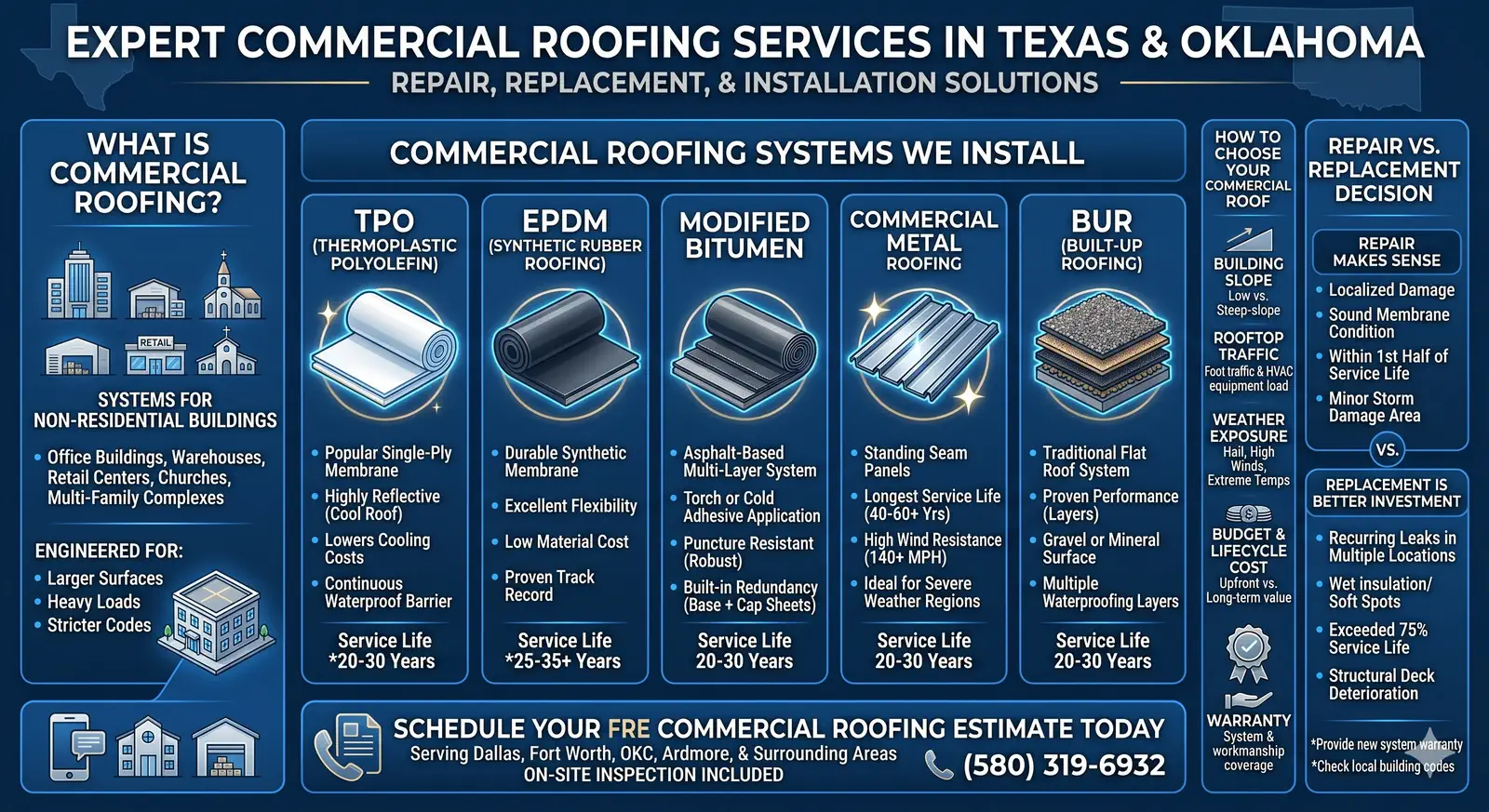
Commercial roofing refers to the design, installation, repair, and maintenance of roofing systems on non-residential buildings. These properties include offices, retail centers, churches, restaurants, industrial facilities, warehouses, and multi-family apartment complexes. Unlike most residential roofing projects, which typically involve pitched roofs with asphalt shingles, commercial buildings often feature low-slope or flat roof designs that require entirely different materials, drainage strategies, and installation methods.
The distinction matters for property owners because commercial roofing systems are engineered to cover significantly larger surface areas, handle heavier mechanical loads from HVAC equipment and foot traffic, and meet stricter building code requirements under the International Building Code (IBC). According to the National Roofing Contractors Association (NRCA), the commercial roofing industry in the United States generates over $30 billion annually, reflecting the scale and complexity of these projects compared to residential work.
Commercial roofs also differ in how they are maintained. Whereas a homeowner might go years without thinking about their roof, a commercial building owner needs a proactive maintenance schedule to protect the warranty, prevent costly interior damage, and extend the system’s service life. That is why Safe Roof offers ongoing roofing services tailored to the unique demands of commercial properties in our service area.
Types of Commercial Roofing Systems We Install in Texas & Oklahoma
Choosing the right roofing system for your commercial building is one of the most consequential decisions you will make as a property owner or facility manager. Each system comes with its own performance characteristics, lifespan expectations, cost profile, and maintenance requirements. Below, we break down the five most widely installed commercial roofing systems in the Ardmore, Oklahoma City, and Dallas–Fort Worth markets.
TPO Roofing Systems (Thermoplastic Polyolefin)
TPO has become the most popular single-ply commercial roofing membrane in the United States over the past two decades. The material is a blend of polypropylene and ethylene-propylene rubber, heat-welded at the seams to create a continuous waterproof barrier. TPO’s rapid adoption across the commercial market is driven by three primary advantages: strong reflectivity that lowers cooling costs in hot climates like Oklahoma, competitive pricing relative to PVC, and straightforward installation that reduces labor time on large-footprint buildings.
For property owners in Ardmore and throughout Carter County, TPO is an especially practical choice because of the region’s intense summer heat. A white TPO membrane can reflect up to 85 percent of solar radiation, which translates directly into reduced air conditioning loads and lower utility bills during the six-month stretch when daytime highs regularly exceed 90°F. TPO systems typically carry a service life of 20 to 30 years with proper maintenance and are available in 45-mil, 60-mil, and 80-mil thicknesses depending on the level of durability required.
EPDM Roofing Systems (Ethylene Propylene Diene Monomer)
EPDM is a synthetic rubber membrane that has been a mainstay of the commercial roofing industry since the 1960s. Often referred to as “rubber roofing,” EPDM is valued for its exceptional flexibility at low temperatures, its proven track record of 30-plus-year service lives, and its relatively low material cost. The membrane is available in black and white, with the black variant offering superior UV resistance and the white variant providing better reflectivity.
EPDM is particularly well-suited to buildings with complex roof geometries, multiple penetrations, irregular shapes, or numerous HVAC curbs, because the material can be field-seamed with adhesive or tape to conform to virtually any layout. For commercial property owners who prioritize longevity and low lifecycle cost, EPDM remains one of the most reliable systems on the market.
Modified Bitumen Roofing Systems
Modified bitumen is a multi-layer asphalt-based system that builds on the time-tested principles of traditional built-up roofing (BUR) with the added benefit of polymer modification for improved flexibility and weather resistance. The system is installed in two or more layers, a base sheet and one or more cap sheets, applied using torch application, cold adhesive, or self-adhering technology.
Modified bitumen systems are a strong fit for commercial buildings that need robust puncture resistance, such as facilities with regular rooftop foot traffic or heavy mechanical equipment. The multi-layer construction also provides built-in redundancy: if the cap sheet sustains localized damage, the base sheet continues to protect the building envelope. Modified bitumen typically delivers a service life of 20 to 30 years and is one of the more affordable multi-ply commercial roofing options available today.
Commercial Metal Roofing Systems
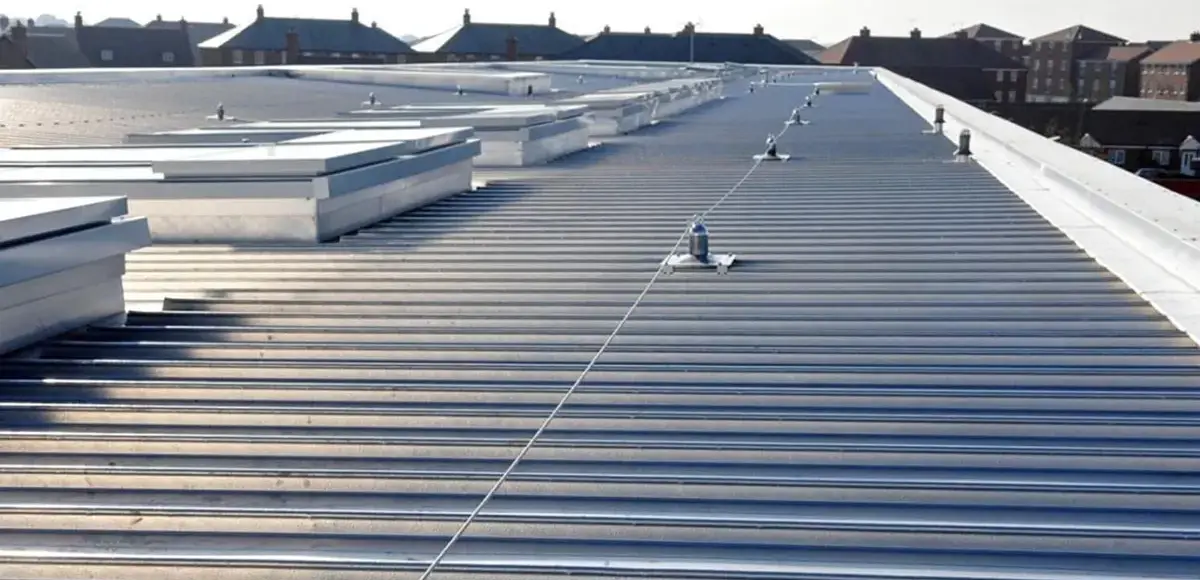
Metal roofing has expanded well beyond its traditional stronghold in agricultural and industrial buildings to become a premium commercial roofing solution for retail, office, and institutional properties. Standing seam metal panels, installed with concealed fasteners and interlocking seams, offer the longest service life of any mainstream commercial system, routinely lasting 40 to 60 years with minimal maintenance.
Metal’s performance advantages are particularly relevant in Oklahoma’s severe weather corridor. Standing seam panels can withstand wind speeds exceeding 140 mph when properly installed, and metal’s non-combustible classification makes it an important safety consideration for buildings in wildfire-adjacent areas. Additionally, metal roofs are fully recyclable at end of life, aligning with the growing demand for sustainable building practices. The Oklahoma Department of Environmental Quality (ODEQ) encourages recyclable building materials as part of the state’s broader waste diversion goals.
Built-Up Roofing (BUR)
Built-up roofing is the oldest commercial flat roofing system still in active use today. BUR consists of alternating layers of bitumen (asphalt or coal tar) and reinforcing fabrics, topped with a gravel ballast or a mineral-surfaced cap sheet. The system’s strength lies in its redundancy; multiple waterproofing layers mean that a single puncture or defect does not compromise the entire system.
BUR remains a practical choice for large, flat-roof commercial buildings where budget and proven performance are top priorities. The system typically lasts 20 to 30 years, and its gravel surface layer provides excellent fire resistance and UV protection. However, BUR is heavier than single-ply alternatives, so structural load capacity must be confirmed before installation.
Areas We Serve
Licensed Commercial & Residential Roofing Contractor
Trusted and licensed contractor for commercial and residential roofing—quality materials, expert service, and lasting protection guaranteed.
LICENSE NUMBER: 80004931
Commercial Roofing System Comparison
Selecting the right system requires balancing lifespan, cost, performance characteristics, and the specific demands of your building. The table below provides a side-by-side comparison of the five primary commercial roofing systems Safe Roof installs across our Ardmore, Oklahoma City, and Dallas–Fort Worth service areas.
System | Typical Lifespan | Cost Range (per sq ft installed) | Best For | Wind Resistance | Energy Efficiency |
TPO | 20–30 years | $5.50–$8.50 | Budget-conscious owners needing high reflectivity | Up to 110 mph | Excellent (white membrane reflects up to 85% of solar radiation) |
EPDM | 25–35 years | $4.50–$7.50 | Complex roof layouts, cold-climate flexibility | Up to 110 mph | Good (white); Moderate (black) |
Modified Bitumen | 20–30 years | $5.00–$9.00 | High foot traffic areas, mechanical equipment zones | Up to 100 mph | Moderate (cap sheet dependent) |
Metal (Standing Seam) | 40–60 years | $8.00–$14.00 | Long-term investment, severe weather regions | Up to 140+ mph | Excellent (cool-coat finishes available) |
BUR (Built-Up Roofing) | 20–30 years | $5.50–$9.50 | Large flat roofs, budget-focused projects | Up to 100 mph (gravel ballast) | Moderate |
Note: Cost ranges are general estimates for the southern Oklahoma and North Texas markets and will vary based on building size, access complexity, insulation requirements, and current material pricing. Contact Safe Roof for a free roof quote specific to your property.
How to Choose the Right Commercial Roof in Oklahoma & Texas
The “best” commercial roofing system does not exist in a vacuum, it depends entirely on your building’s structural characteristics, your operating budget, your long-term ownership plans, and the specific weather threats in your area. Here is a framework Safe Roof uses to guide commercial property owners through the decision:
- Building structure and slope: Low-slope and flat-roof buildings are candidates for TPO, EPDM, modified bitumen, or BUR. Steep-slope commercial buildings, such as churches, restaurants, or mixed-use retail, may benefit from standing seam metal or even architectural shingles on appropriate applications.
- Rooftop equipment and foot traffic: Buildings with heavy HVAC units, solar panel arrays, or regular maintenance access need systems with high puncture resistance. Modified bitumen and BUR handle these demands well. TPO and EPDM can also perform in these environments with additional walk pads and reinforcement at penetrations.
- Climate and weather exposure: Ardmore sits squarely in the heart of Tornado Alley, and commercial buildings here face annual exposure to hail, high winds, and extreme temperature swings. For properties prioritizing wind resistance above all else, standing seam metal is the strongest performer. For heat reflectivity and cooling cost savings, white TPO leads the field.
- Budget and lifecycle cost: Initial installation cost is only part of the equation. A metal roof may cost twice as much as TPO upfront, but its 40-to-60-year lifespan means the cost per year of service is often lower. Property owners planning to hold a building for 10 years or less may prioritize lower upfront cost, while long-term holders benefit from investing in durability.
- Warranty requirements: Manufacturer warranties on commercial roofing systems range from 10 to 30 years depending on the product and the installation specifications. Safe Roof installs to manufacturer standards and maintains the certifications necessary to offer full system warranties on the products we install.
Why Choose Safe Roof
- Scheduled Around Business Operations — We coordinate commercial projects around your operating hours and business schedule, minimizing disruption to tenants, employees, and customers throughout the installation.
- Permit Coordination Across Both States — Safe Roof handles permit requirements across Texas and Oklahoma municipalities, ensuring every commercial installation meets local building code standards without delays.
- Written Estimates with Full Scope Detail — Every commercial quote is fully itemized, system type, membrane thickness, drain count, flashing scope, and warranty tier, so property managers can plan capital expenditure accurately.
- Storm Damage Documentation — After major hail or wind events, Safe Roof documents commercial roof damage to the standard carriers and adjusters, identifying scope items that underpaid estimates consistently miss across the DFW metro and South Oklahoma.
- GAF-Certified Installation Standards — Every commercial installation meets the quality standards required to activate enhanced manufacturer warranty coverage, giving property owners documented long-term protection on their investment.
- Licensed and Insured in Both States — Oklahoma Roofing Contractor #80004931. Full general liability and workers’ compensation coverage across Texas and Oklahoma on every commercial job.
Commercial Roofing Cost Factors
Understanding what drives commercial roofing costs allows property owners to budget accurately and avoid surprises during the project. The total cost of a commercial roof installation or replacement depends on several interconnected variables, and the table below outlines the most significant factors affecting your bottom line.
Cost Factor | Impact on Total Cost | Details |
Roof Size (total square footage) | High | Larger roofs benefit from economies of scale but still represent the single largest cost variable. A 10,000 sq ft roof will cost significantly more in total than a 3,000 sq ft roof, even though the per-square-foot rate may be lower. |
System Type | High | Material and labor rates vary widely by system. TPO and EPDM are generally the most affordable single-ply options, while standing seam metal carries a premium. |
Tear-Off vs. Overlay | Medium–High | Removing the existing roof system down to the deck adds labor and disposal costs but is often required by code or manufacturer warranty specifications. |
Insulation Requirements | Medium | Energy codes in Oklahoma and Texas mandate minimum R-values for commercial roof assemblies. Upgrading insulation adds material cost but delivers long-term energy savings. |
Roof Access and Height | Medium | Multi-story buildings and properties with limited staging areas require additional safety equipment and logistics, increasing labor costs. |
Number of Penetrations | Medium | HVAC curbs, vent stacks, skylights, and drains each require custom flashing and detailing, adding labor time. |
Warranty Level | Low–Medium | Extended or full-system manufacturer warranties may require additional material specifications (thicker membrane, additional adhesive) that increase material cost. |
Permits and Code Compliance | Low | Permit fees and any required structural upgrades to meet current IBC or local building codes. |
For a detailed estimate tailored to your commercial property, request a free roof quote from Safe Roof or call us directly at (580) 319-6932.
Commercial Roof Maintenance and Inspections
A well-maintained commercial roof consistently outperforms a neglected one, not just in longevity, but in total cost of ownership. Industry data suggests that proactive maintenance programs can extend a commercial roof’s service life by 25 to 50 percent compared to a reactive, repair-only approach. For a TPO system rated at 25 years, that could mean an additional 6 to 12 years of reliable performance before a full roof replacement becomes necessary.
Safe Roof recommends semi-annual inspections for all commercial roofing clients, once in the spring after winter freeze-thaw cycles and again in the fall before Oklahoma’s severe weather season. These inspections cover membrane condition, seam integrity, flashing at penetrations, drainage system function, and the condition of any rooftop-mounted equipment. Our inspection process also includes documentation and photography that can support insurance claims assistance if storm damage is identified.
Between professional inspections, commercial property owners and facility managers should monitor for standing water after rain events, visible membrane blistering or cracking, flashing separation at parapet walls, and any loose or displaced material following severe weather. Catching these issues early through routine leak detection protocols can prevent minor problems from escalating into costly interior damage.
Commercial Roof Repair vs. Replacement
One of the most common questions commercial property owners ask is whether an aging roof needs repair or full replacement. Making the right call can save tens of thousands of dollars, or prevent a short-sighted repair from delaying an inevitable replacement. Here is how to evaluate the decision:
When Repair Makes Sense
- Roof is within the first half of its expected service life — A commercial roof with significant remaining lifespan is a strong repair candidate when damage is localized and the overall membrane condition is sound.
- Damage is confined to a specific area — Seam failures on single-ply membranes, punctures from foot traffic or debris impact, and localized flashing failure at penetrations are all appropriate targets for targeted roof repair.
- Storm damage covers a small percentage of the total roof area — Hail damage or wind damage confined to a minor portion of the surface is typically more cost-effective to repair than replace, provided the underlying membrane and insulation are intact.
- Membrane condition is structurally sound — If a professional roof inspection confirms the membrane has no widespread adhesion failure, seam separation, or moisture intrusion beyond the damaged area, repair is the right call.
When Replacement Is the Better Investment
- Roof has exceeded 75 percent of its expected service life — At this stage, continued patching typically costs more per year than a replacement amortized over the new system’s full lifespan.
- Recurring leaks in multiple locations — When leaks appear in different areas across multiple repair cycles, the roof system is failing broadly, not at isolated points. Every repair dollar at this stage could be applied toward a new system with a fresh warranty.
- Insulation beneath the membrane is saturated — Wet insulation loses its thermal value, adds structural load, and accelerates membrane deterioration from below. Once insulation saturation is widespread, replacement is the only complete remedy.
- Structural deck shows signs of deterioration — Soft spots, delamination, or moisture damage in the decking beneath the membrane require full replacement, a repair cannot address compromised structural substrate.
- Storm damage covers 25 percent or more of the roof surface — At this threshold, most Texas and Oklahoma commercial insurance carriers approve full replacement over partial repair. Safe Roof documents commercial storm damage to the standard required for full replacement approval.
Safe Roof provides honest, data-driven assessments. We do not recommend replacement when repair will solve the problem, and we do not recommend repair when the roof is telling us it is time for a new system. Our structural roof repair evaluations include deck inspections and moisture mapping to give you the full picture before you commit to either path.
What Our Customers Say
Proudly Serving Texas & Oklahoma With Expert Commercial Roofing Services
Safe Roof provides licensed, GAF-certified commercial roofing services to businesses, property managers, and commercial developers across our full Texas and Oklahoma service area, from warehouse districts and retail centers in the DFW Metroplex to office properties and industrial facilities across South-Central Oklahoma, where storm exposure, operational scheduling demands, and long-term warranty protection make choosing the right commercial roofing contractor one of the most consequential property decisions a business owner can make. Our service areas include: Dallas, Far North Dallas, Fort Worth, Prosper, Celina, Plano, Sherman, McKinney, Oklahoma City, Ardmore and surrounding areas. If you are looking for a broader view of our coverage, then see our full service area page here.
Schedule Your Free Commercial Roofing Estimate in Texas & Oklahoma Today
A failing commercial roof does not just mean repair costs, it means business interruption, inventory exposure, tenant disputes, and liability risk that compound the longer the problem goes unaddressed. Safe Roof provides free commercial roof inspections and written, itemized estimates across our full Texas and Oklahoma service area, giving property managers and business owners the documentation and scope detail needed to plan capital expenditure accurately and act before a manageable problem becomes an emergency.
Call (580) 319-6932, visit our free roof quote page, or reach out through our contact page to schedule your free commercial roofing inspection and estimate today.
Frequently Asked Questions
If your commercial roof is within the first half of its expected service life and damage is localized, targeted roof repair is typically the most cost-effective path. If the roof has exceeded 75 percent of its expected lifespan, you are experiencing recurring leaks in multiple locations, or insulation beneath the membrane is saturated, replacement is almost always more economical than continued patching. Safe Roof’s free commercial roof inspection gives you a specific recommendation based on your property’s actual condition.
There is no single best system, the right choice depends on building type, budget, climate exposure, and long-term plans. In the DFW metro and Oklahoma markets, TPO is the most commonly installed system for new flat-roof construction due to its balance of cost, reflectivity, and durability in high-heat conditions. For property owners prioritizing maximum lifespan, standing seam metal roofing is the premium choice. Safe Roof evaluates each property individually and recommends the system that best matches your priorities.
Commercial roofing costs across Texas and Oklahoma typically range from $4.50 to $14.00 per square foot installed, depending on system type, building complexity, and insulation requirements. A 10,000 square foot TPO installation might fall in the $55,000 to $85,000 range, while the same footprint in standing seam metal could run $80,000 to $140,000. Request a free roof quote from our team for an accurate estimate on your specific property.
Service life varies by system. TPO and EPDM systems typically last 20 to 35 years, modified bitumen and BUR last 20 to 30 years, and standing seam metal can exceed 50 years. These ranges assume professional installation and a regular maintenance program; according to the National Roofing Contractors Association, commercial roofs that receive scheduled annual inspections last 30 to 40 percent longer than those addressed only reactively.
Yes. Safe Roof’s storm damage roofing team works directly with commercial property owners and their insurance adjusters to document damage, prepare scope-of-loss reports, and ensure claims are filed accurately. We have extensive experience with hail damage and wind damage claims across the Oklahoma City, Ardmore, and DFW markets.
At minimum twice per year, once before storm season and once after. Given that Texas and Oklahoma sit in Tornado Alley and NOAA records Oklahoma averaging more than 50 significant hail days annually, post-storm inspections after any significant hail or wind event are also strongly recommended. Early detection of membrane seam failures, drain blockages, and flashing issues prevents the interior damage and business interruption that deferred commercial roof maintenance consistently creates.
Yes. Safe Roof handles permit coordination across Texas and Oklahoma municipalities where permits are required for commercial roofing projects, ensuring every installation meets local building code standards before work begins. Permit requirements vary by city and county across both states, and Safe Roof guides property owners and managers through the specific requirements for their location before any work is scheduled.
Safe Roof
Business Hours
Monday: Open 24 hours
Tuesday: Open 24 hours
Wednesday: Open 24 hours
Thursday: Open 24 hours
Friday: Open 24 hours
Saturday: Open 24 hours
Sunday: Open 24 hours
Book a Free Inspection
Our Services
Safe Roof
Business Hours
Monday: Open 24 hours
Tuesday: Open 24 hours
Wednesday: Open 24 hours
Thursday: Open 24 hours
Friday: Open 24 hours
Saturday: Open 24 hours
Sunday: Open 24 hours
Your Elite Residential and Commercial Roofing Team in Texas & Oklahoma
Whether you’re dealing with storm damage, planning a replacement, or just want a professional opinion on your roof’s condition, Safe Roof is ready to help. We serve property owners across Texas and Oklahoma, showing up on time, doing the work right, and standing behind every install with GAF-certified warranty coverage.
Getting an estimate costs nothing and commits you to nothing. We’ll assess your roof, walk you through the findings, and provide a clear written estimate.